

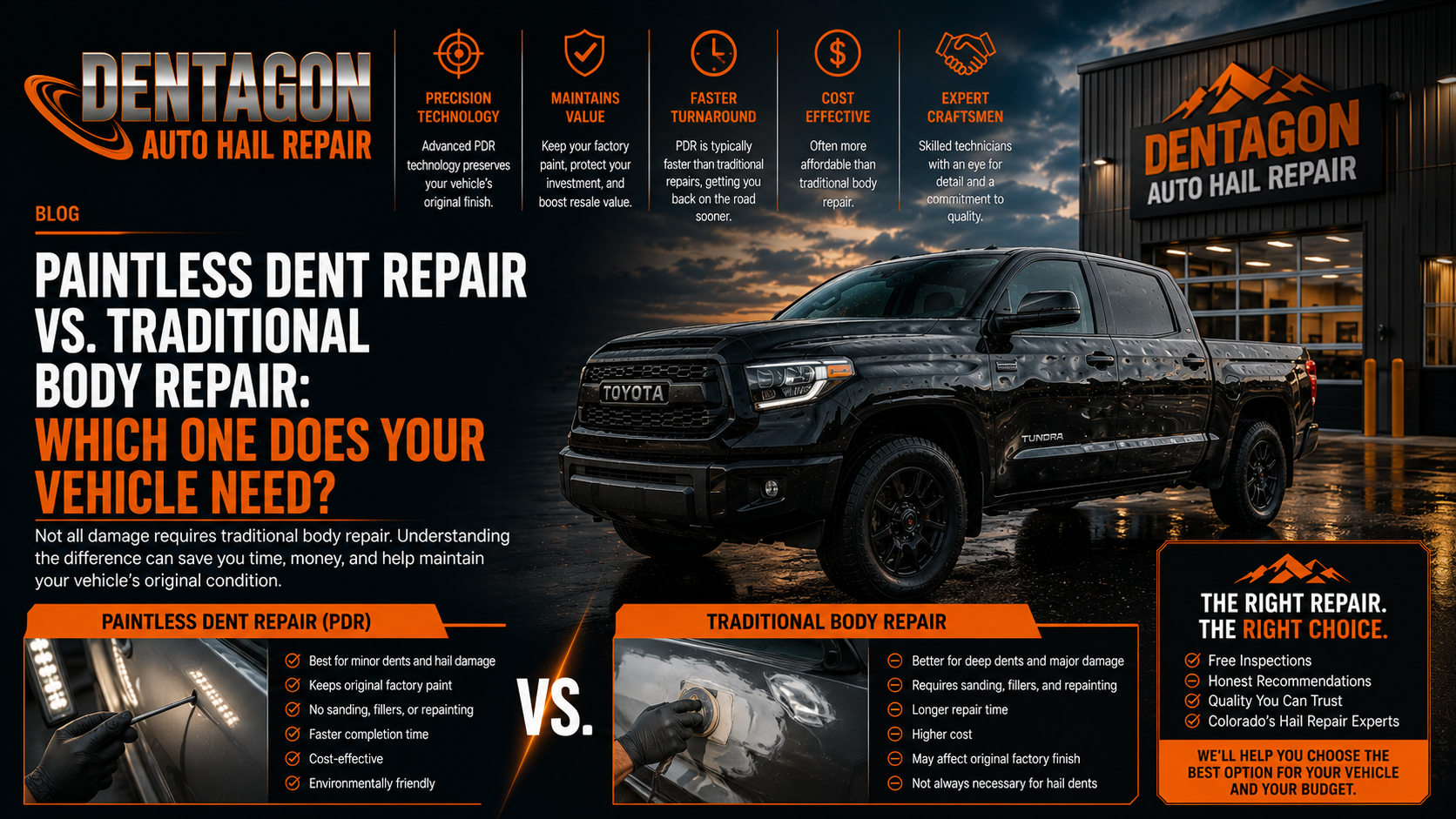
Paintless Dent Repair vs. Traditional Body Repair: Which One Does Your Vehicle Need?
If your vehicle has been damaged by a Colorado hail storm, one of the first questions you’ll hear is whether it qualifies for Paintless Dent Repair (PDR) or if it will need traditional body repair. While both repair methods are designed to restore your vehicle, they are used in very different situations.
At Dentagon Auto Hail Repair, our goal is always to use the repair method that provides the best long-term results while preserving your vehicle’s appearance, value, and structural integrity. Understanding the differences between these repair techniques can help you know what to expect before the repair process begins.
What Is Paintless Dent Repair?
Paintless Dent Repair, commonly called PDR, is a specialized repair technique that removes dents without sanding, body filler, or repainting the vehicle.
Using specialized tools, highly trained technicians carefully massage the damaged metal back into its original shape from behind the panel whenever possible. When rear access isn’t available, approved glue-pulling techniques may be used on factory-painted panels.
Because the original paint remains intact, the vehicle maintains its factory finish.
When Is Paintless Dent Repair the Best Option?
Paintless Dent Repair is often the preferred repair method when:
- The paint has not been cracked or chipped.
- The dent isn’t excessively deep.
- The metal hasn’t been severely stretched.
- The damaged area can be safely accessed.
- The panel maintains its original structural integrity.
Many hail-damaged vehicles qualify for PDR because hail typically creates numerous small dents without damaging the paint.
Benefits of Paintless Dent Repair
There are several advantages to Paintless Dent Repair.
Preserves Your Factory Paint
One of the biggest benefits of PDR is that your vehicle keeps its original factory finish. Since no repainting is required, there’s no concern about blending new paint or matching the original color.
Faster Repairs
Because technicians aren’t sanding, filling, priming, or painting damaged panels, repairs can often be completed more quickly than traditional body repairs.
Maintains Vehicle Value
Original factory paint is an important factor in maintaining resale value. Preserving the factory finish may make the repair less noticeable to future buyers.
Environmentally Friendly
Paintless Dent Repair produces very little waste and doesn’t require paints, solvents, or fillers commonly used during conventional body repairs.
When Traditional Body Repair Is Necessary
Not every dent can be repaired using Paintless Dent Repair.
Traditional body repair becomes necessary when:
- Paint has been cracked or chipped.
- Metal has been severely stretched.
- Sharp creases are present.
- Panels are torn or punctured.
- Structural damage has occurred.
- A panel must be replaced.
In these situations, restoring the vehicle properly requires conventional repair techniques.
What Does Traditional Body Repair Involve?
Traditional collision repair typically includes several steps:
- Removing damaged parts
- Repairing or replacing body panels
- Applying body filler when appropriate
- Sanding damaged areas
- Priming repaired surfaces
- Computerized paint matching
- Applying new paint and clear coat
- Blending adjacent panels when necessary
- Reassembling the vehicle
- Performing quality inspections
Although the process takes longer than PDR, it’s often the only way to restore more significant damage safely and correctly.
Can a Vehicle Need Both Repair Methods?
Absolutely.
In fact, many hail-damaged vehicles receive a combination of both repair techniques.
For example:
- The roof may qualify for Paintless Dent Repair.
- The hood may require replacement because the metal is stretched.
- A damaged fender may need conventional refinishing.
- The doors may be repaired using PDR.
Every repair plan is customized based on the actual condition of the vehicle.
How Do Technicians Decide?
Several factors determine which repair method should be used.
Our technicians evaluate:
- Dent size
- Dent depth
- Number of dents
- Location of damage
- Panel material
- Paint condition
- Accessibility behind the panel
- Previous body repairs
- Structural damage
This detailed inspection allows us to recommend the safest and most effective repair solution.
Will Insurance Cover Paintless Dent Repair?
If your vehicle has comprehensive insurance coverage and the hail damage is covered under your policy, insurance generally pays for the appropriate repair method.
Whether that ends up being Paintless Dent Repair, conventional body repair, or a combination of both depends on the inspection—not the customer’s preference.
Dentagon works directly with all major insurance companies to help simplify the claims process and coordinate any necessary supplements if additional damage is discovered.
Is Paintless Dent Repair Better Than Traditional Body Repair?
Neither repair method is “better” in every situation.
Paintless Dent Repair is ideal when the damage allows it because it preserves the original paint and often shortens repair time.
Traditional body repair is the correct choice when damage exceeds the limits of PDR. Attempting to perform Paintless Dent Repair on severely damaged panels could lead to poor results and compromise the quality of the repair.
The best repair is always the one that restores your vehicle properly and safely.
Why Choose Dentagon Auto Hail Repair?
At Dentagon Auto Hail Repair, every vehicle receives a thorough inspection before repairs begin.
Our experienced technicians evaluate the damage carefully to determine which repair method will deliver the best results—not simply the fastest solution.
Whether your vehicle qualifies for Paintless Dent Repair, traditional body repair, or a combination of both, our goal is to restore it to pre-storm condition with professional craftsmanship and attention to detail.
Frequently Asked Questions
Can every hail dent be repaired with Paintless Dent Repair?
No. While many hail dents qualify for PDR, cracked paint, severe creases, stretched metal, or structural damage may require traditional body repair.
Will Paintless Dent Repair affect my vehicle’s paint?
No. Properly performed Paintless Dent Repair preserves your original factory paint because no sanding or repainting is required.
Is Paintless Dent Repair permanent?
Yes. Once the metal has been properly restored, the repair is permanent and does not wear out over time.
Does Paintless Dent Repair work on aluminum panels?
In many cases, yes. However, aluminum behaves differently than steel and requires specialized tools and experience. A professional inspection is necessary to determine repairability.
Which repair method is less expensive?
Paintless Dent Repair is often less expensive because it eliminates the need for paint and body materials. However, the appropriate repair method is determined by the damage—not by cost alone.
Schedule Your Free Hail Damage Inspection
If your vehicle has suffered hail damage, don’t guess which repair method it needs.
The experienced team at Dentagon Auto Hail Repair will perform a free professional inspection, explain your repair options, and work directly with your insurance company to make the process as smooth as possible.
Whether your vehicle qualifies for Paintless Dent Repair, traditional body repair, or a combination of both, we’re committed to restoring your vehicle with quality workmanship and exceptional customer service.