

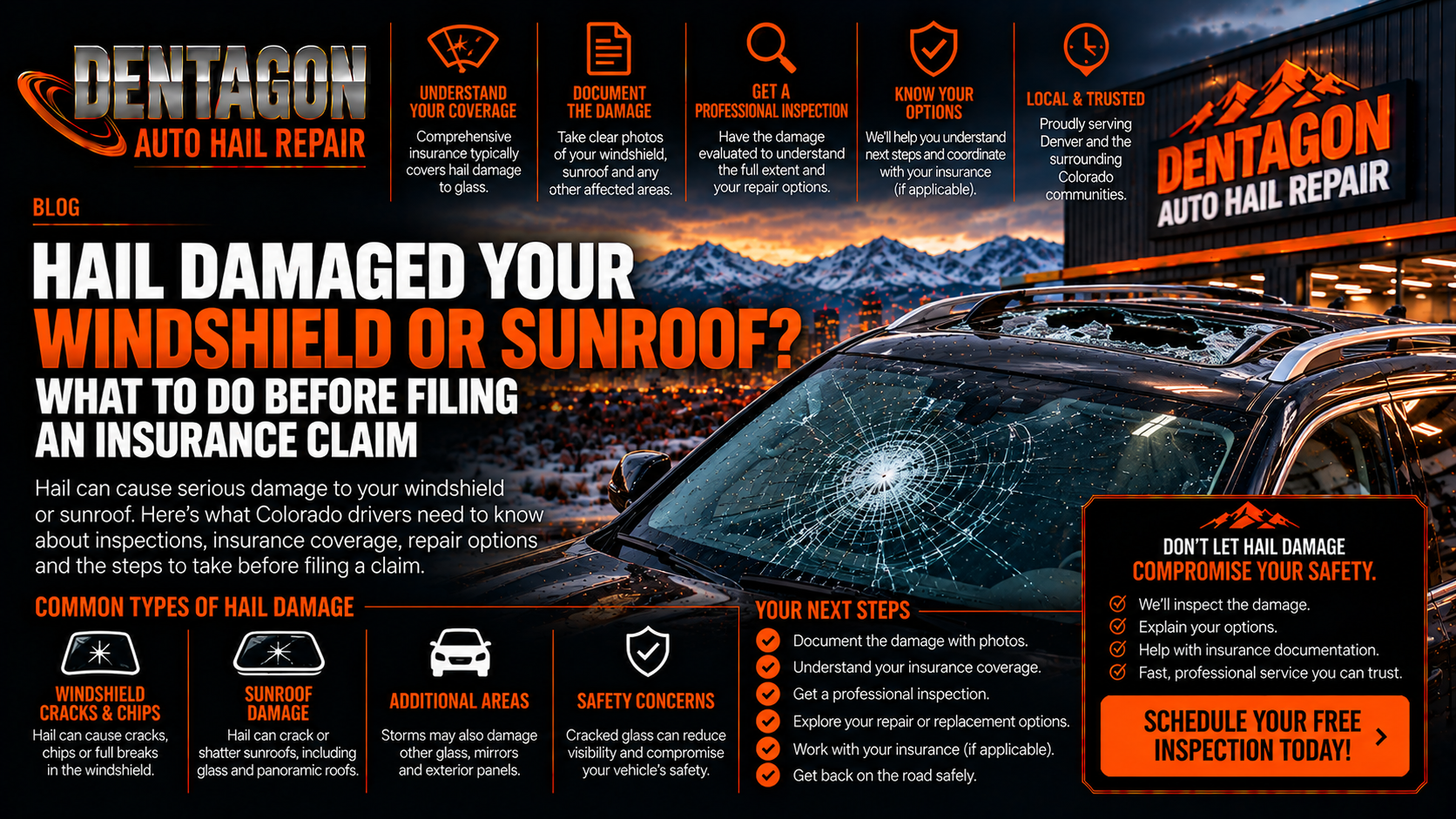
Hail Damaged Your Windshield or Sunroof? What to Do Before Filing an Insurance Claim
A Colorado hailstorm just rolled through your neighborhood. You walk outside to inspect your vehicle and discover a cracked windshield, damaged sunroof, or shattered glass scattered across the interior. Now you’re wondering what to do first—and whether your insurance will cover the damage.
Most drivers associate hail damage with dents on the hood, roof, and trunk. But when hailstones are large enough, they can also crack windshields, break sunroofs, and damage other automotive glass.
The important thing to understand is that hail-related glass damage and body damage may be part of the same insurance claim, but they can require different repair procedures.
Replacing damaged glass without checking the rest of your vehicle could mean overlooking dozens of hail dents. Likewise, focusing only on body damage while ignoring compromised glass can create serious safety concerns.
At Dentagon, we specialize in automotive hail damage repair and Paintless Dent Repair (PDR) throughout the Denver metro area. We also assist customers with repair-related insurance documentation and communication.
If hail has damaged your windshield, sunroof, or other vehicle glass, here’s what you need to know before moving forward with an insurance claim.
Can Hail Really Crack or Shatter a Windshield?
Yes. Large hailstones can crack, chip, or severely damage automotive windshields, particularly during intense storms involving high winds.
Windshields are designed to withstand normal driving conditions and certain impacts, but they aren’t indestructible.
The severity of hail damage depends on several factors, including:
-
Hailstone size: Larger hailstones generally carry more energy and can cause more significant damage.
-
Wind speed: Strong winds can increase the force and direction of hail impacts.
-
Impact angle: The angle at which hail strikes the glass affects how force is distributed.
-
Existing glass damage: Previous chips or cracks may make the windshield more vulnerable.
-
Vehicle position: A car facing into a hailstorm may experience different damage than one parked in the opposite direction.
While smaller hailstones may leave the windshield untouched, larger impacts can create chips, spreading cracks, or more extensive damage.
Why Windshields Don’t Always Shatter Completely
Most modern automotive windshields are made from laminated safety glass.
This construction typically consists of two layers of glass bonded to a plastic interlayer.
The interlayer helps hold broken glass together and reduces the likelihood of the windshield breaking into loose pieces.
However, laminated glass can still crack extensively, lose visibility, or become unsafe to drive with.
A damaged windshield should be evaluated by a qualified automotive glass professional to determine whether repair or replacement is appropriate.
Can Hail Break a Car’s Sunroof or Panoramic Roof?
Absolutely.
Sunroofs and panoramic glass roofs can sustain significant damage during severe hailstorms.
Unlike most windshields, many sunroofs use tempered safety glass, although construction varies by vehicle.
Tempered glass is designed to break into numerous small pieces rather than large, sharp shards.
That design provides certain safety benefits, but it also means a severe impact may cause the glass panel to break apart.
What Happens When a Sunroof Shatters?
A broken sunroof can create several immediate problems:
Glass Inside the Vehicle
Fragments may fall onto seats, carpeting, consoles, and other interior surfaces.
Water Intrusion
Rainwater can enter through the damaged opening and affect upholstery, carpeting, electronics, and interior components.
Exposure to Additional Weather
If the vehicle remains outdoors, another storm can cause further damage.
Compromised Vehicle Security
A broken roof opening may leave the vehicle vulnerable to theft or unauthorized access.
What About Panoramic Glass Roofs?
Panoramic roofs often cover a larger portion of the vehicle than traditional sunroofs.
Their construction varies by manufacturer and model, and some incorporate laminated glass or additional protective layers.
Because of their size, design, and integration with vehicle components, replacement can be more involved than repairing a conventional glass panel.
If your panoramic roof is damaged, the appropriate repair should follow the vehicle manufacturer’s specifications.
What Should You Do Immediately After Hail Damages Your Windshield or Sunroof?
The first few steps after a hailstorm can help protect your vehicle, document the damage, and prevent additional problems.
Step 1: Make Sure the Vehicle Is Safe
Before inspecting the damage, confirm that the storm has passed and conditions are safe.
If the windshield is severely cracked, the sunroof is shattered, or glass fragments are present inside the vehicle, avoid unnecessary driving.
A damaged windshield can interfere with visibility, and broken glass inside the cabin creates additional hazards.
If you’re unsure whether the vehicle is safe to operate, arrange for professional assistance rather than taking the risk.
Step 2: Photograph the Damage
Take clear photographs of all visible damage before cleaning or making temporary repairs, provided it’s safe to do so.
Document:
-
Windshield cracks and impact points
-
Broken sunroof or panoramic roof glass
-
Glass fragments inside the vehicle
-
Dents on the hood, roof, trunk, and doors
-
Damaged exterior trim
-
Water intrusion or visible interior damage
Capture both close-up photographs and wider images showing the affected areas.
These records may be useful when communicating with your insurance company.
Step 3: Protect the Interior From Additional Weather
If the sunroof or another glass panel is broken, move the vehicle into a garage or covered location if it can be done safely.
If indoor storage isn’t available, ask a qualified professional about temporary protection.
Avoid applying adhesives or materials directly to painted surfaces without understanding whether they could damage the finish.
Temporary coverings should never obstruct the driver’s view or make the vehicle unsafe to operate.
Step 4: Inspect the Rest of the Vehicle
Don’t stop at the broken glass.
A hailstorm powerful enough to damage automotive glass may also leave extensive dents across the vehicle’s body panels.
Check the hood, roof, trunk, doors, fenders, and other exposed surfaces.
Remember that some hail dents are difficult to identify without professional inspection lighting.
Step 5: Contact Your Insurance Company
Report the damage according to your policy’s requirements.
Ask about your comprehensive coverage, deductible, claim procedures, approved repair process, and any documentation the insurer needs.
If the vehicle isn’t safe to drive, ask whether your policy provides applicable towing or transportation benefits.
Does Comprehensive Insurance Cover Hail Damage to Windshields and Sunroofs?
Comprehensive auto insurance generally covers qualifying hail damage to vehicle glass and body panels, subject to the policy’s terms, exclusions, limits, and deductible.
Comprehensive coverage is designed to address certain types of damage that aren’t caused by a collision.
Covered events commonly include hailstorms, falling objects, theft, vandalism, and other specified incidents.
However, the exact coverage available depends on your insurance policy.
Does Liability-Only Insurance Cover Hail Damage?
Typically, no.
Liability insurance generally covers certain injuries or property damage you cause to others. It does not ordinarily pay to repair hail damage to your own vehicle.
If you carry liability-only coverage without comprehensive insurance, hail-related repairs may be your financial responsibility.
Is Windshield Damage Covered Differently From Body Damage?
Sometimes.
Certain insurance policies offer separate glass coverage, reduced glass deductibles, or specific provisions for windshield repair or replacement.
Other policies apply the regular comprehensive deductible.
Colorado drivers should not assume that windshield replacement is automatically free or that a zero-deductible glass benefit applies to every policy.
Review your coverage or contact your insurer to confirm the benefits available.
Can Windshield and Body Hail Damage Be Included in the Same Insurance Claim?
Often, yes. Damage caused by the same hailstorm may be evaluated as part of one comprehensive insurance claim.
For example, a single storm might cause:
-
A cracked windshield
-
A shattered sunroof
-
Multiple dents across the hood
-
Hail damage on the roof and trunk
-
Damaged exterior moldings or trim
Because these damages resulted from the same event, the insurer may handle them together under one claim.
However, claim handling, deductibles, coverage provisions, and repair arrangements depend on the policy and insurer.
Why a Complete Vehicle Inspection Matters
One common mistake after a severe hailstorm is focusing entirely on the most obvious damage.
A cracked windshield demands immediate attention, so drivers may arrange glass replacement without realizing that the hood and roof also sustained dozens of dents.
If those dents aren’t identified and documented, the initial insurance estimate may not reflect the full extent of the storm damage.
A professional hail damage inspection can help identify affected body panels before repair planning is finalized.
What If Additional Hail Damage Is Found Later?
If additional storm-related damage is discovered during inspection or repairs, the repair facility may document the findings and communicate them to the insurance company.
A supplemental estimate may be submitted for review when appropriate.
The insurer determines whether additional repairs are covered under the applicable policy.
At Dentagon, we help customers navigate repair-related documentation and insurance communication so they better understand the process.
Should You Repair the Windshield Before Fixing Hail Dents?
The appropriate repair order depends on the severity of the damage, vehicle safety, insurance requirements, and the work being performed.
Safety-related glass damage should be addressed promptly, but it’s also important to evaluate the entire vehicle before coordinating repairs.
When Glass Damage Needs Immediate Attention
A windshield may require prompt professional evaluation when:
-
Cracks interfere with the driver’s view
-
Damage is extensive or spreading
-
Glass is loose or severely compromised
-
A sunroof or roof panel has shattered
-
Water is entering the cabin
-
Vehicle safety systems may be affected
If the vehicle is unsafe to drive, don’t delay appropriate glass repair simply to complete cosmetic dent repairs first.
Why Coordinating Repairs Can Be Helpful
Some hail repairs require technicians to access areas behind the vehicle’s exterior panels.
Depending on the vehicle and the damage, certain interior trim components may need to be removed or carefully repositioned.
Coordinating body and glass repairs can help reduce unnecessary duplication of work and clarify the overall repair plan.
However, the sequence should be determined by qualified repair professionals following applicable manufacturer procedures.
Can Paintless Dent Repair Fix Hail Damage Around a Windshield or Sunroof?
In many cases, Paintless Dent Repair can correct qualifying dents on metal panels surrounding automotive glass.
However, repairability depends on the dent’s location, severity, paint condition, and accessibility.
Hail Dents on the Roof
The roof is one of the most common areas affected by hail.
Many shallow roof dents can be repaired using PDR when the paint remains intact and the metal can be safely restored.
However, roof construction varies significantly between vehicles.
Some roof panels include reinforcements, adhesives, or other structural components that affect access and repair methods.
Dents Near the Windshield
Hail can damage the metal around the windshield opening, including adjacent roof areas and pillars.
These locations may be more challenging because of limited accessibility, complex body contours, and nearby structural components.
A qualified technician must evaluate whether PDR is appropriate.
Dents Around a Sunroof Opening
The metal surrounding a sunroof or panoramic roof may also sustain hail damage.
However, these areas can contain reinforcement structures, drainage systems, seals, and mechanical components.
Repairs must account for those systems and should not interfere with their operation.
Not every dent near automotive glass qualifies for PDR, particularly when the damage affects structural components or requires manufacturer-specific procedures.
Can Hail Damage Affect Your Vehicle’s Safety Sensors?
Yes. Severe hail damage or windshield replacement can involve vehicle systems beyond the visible glass.
Many modern vehicles use advanced driver assistance systems, commonly called ADAS.
These systems may include cameras, sensors, and other components that support features such as:
-
Lane departure warnings
-
Lane keeping assistance
-
Forward collision warnings
-
Automatic emergency braking
-
Adaptive cruise control
-
Traffic sign recognition
Some forward-facing cameras are mounted near the windshield.
Why Windshield Replacement May Require ADAS Calibration
Replacing a windshield can affect the position or alignment of a camera mounted to or near the glass.
Depending on the vehicle manufacturer’s requirements, calibration may be necessary after replacement.
Calibration helps ensure that applicable systems operate according to their intended specifications.
The requirements vary by vehicle make, model, equipment, and repair procedure.
What Should You Ask Before Replacing Your Windshield?
Ask the glass repair provider whether your vehicle has windshield-mounted ADAS equipment and whether manufacturer procedures require calibration.
If calibration is necessary, confirm how it will be performed and documented.
A glass replacement should not be considered complete until all applicable safety-related procedures have been addressed.
What If Your Insurance Estimate Only Includes Glass Damage?
An initial insurance estimate may not identify every dent caused by a hailstorm.
This can happen when damage is subtle, the vehicle is inspected under less-than-ideal lighting, or the initial assessment focuses primarily on the broken glass.
Why Hail Dents Can Be Missed
Small hail dents may blend into the paint and become difficult to see under ordinary lighting.
Professional PDR technicians often use specialized reflection lighting to identify shallow depressions across body panels.
A vehicle with only a few obvious dents may have additional damage on the roof, hood, trunk, or doors.
Can the Estimate Be Updated?
If additional covered damage is identified, the repair facility may provide documentation supporting a supplemental estimate.
This may include photographs, panel-specific damage assessments, dent counts, and recommended repairs.
The insurance company reviews the additional information and determines whether the estimate should be revised.
At Dentagon, our insurance claims assistance helps customers understand repair-related estimates and the documentation process.
Will Insurance Total a Car Because of Hail Damage and Broken Glass?
It’s possible, although broken glass and hail dents don’t automatically make a vehicle a total loss.
Insurance companies generally evaluate the vehicle’s value, the cost of repairs, applicable state requirements, and policy provisions when determining whether a vehicle should be declared a total loss.
A vehicle with extensive hail damage, multiple broken glass panels, and other storm-related damage may require substantial repairs.
If the estimated repair costs meet the applicable total-loss criteria, the insurer may determine that repairing the vehicle is not economically appropriate.
Does a Total Loss Mean the Vehicle Is Undrivable?
Not necessarily.
A vehicle may be declared a total loss for financial or legal reasons even when some components remain functional.
However, damaged glass, compromised visibility, or other safety-related issues can make the vehicle unsafe to operate regardless of its insurance classification.
Can You Keep a Hail-Damaged Vehicle After a Total Loss?
In some situations, an insurer may allow an owner to retain a totaled vehicle, subject to the policy, lienholder requirements, and applicable title and registration rules.
If you’re considering this option, ask your insurer about the settlement, vehicle title status, and any requirements affecting future use or insurance.
How to Protect Your Vehicle From Future Colorado Hailstorms
While no precaution guarantees complete protection against severe hail, a few practical steps can reduce exposure.
Park in a Garage or Covered Structure
Covered parking is generally the most effective way to reduce direct hail impacts.
Whenever possible, move your vehicle into a garage or covered parking facility before severe weather arrives.
Pay Attention to Severe Weather Alerts
Colorado thunderstorms can develop quickly.
Monitoring National Weather Service alerts and local forecasts can give you time to move your vehicle when conditions allow.
Never attempt to relocate your vehicle during dangerous hail, lightning, or severe winds.
Consider a Purpose-Built Hail Protection Cover
Some vehicle covers are designed with padding intended to reduce hail impacts.
Their effectiveness varies based on the product, hail size, installation, and weather conditions.
A cover should not be treated as guaranteed protection against large or wind-driven hail.
Avoid Parking Beneath Unstable Trees
Trees may provide some overhead coverage, but severe thunderstorms can also bring strong winds and falling branches.
Parking beneath vulnerable trees may introduce additional risks.
Why Denver Drivers Should Inspect More Than Just Their Windshield After Hail
Colorado’s Front Range is known for severe thunderstorms that can produce damaging hail.
Drivers throughout Denver, Aurora, Arvada, Westminster, Broomfield, Lakewood, Littleton, Centennial, and surrounding communities may experience hailstorms capable of damaging both automotive glass and exterior body panels.
The challenge is that not all damage is immediately obvious.
A broken windshield is difficult to overlook. A collection of shallow roof dents may be nearly invisible without proper inspection lighting.
That difference can lead vehicle owners to underestimate the extent of the damage.
A complete post-storm assessment should consider both the obvious glass damage and any less-visible damage to the vehicle’s exterior panels.
Addressing the full scope of damage early can help with repair planning, insurance documentation, and avoiding unnecessary complications later.
Don’t Let Broken Glass Distract You From Hidden Hail Damage
When hail cracks your windshield or shatters your sunroof, your immediate priority should be safety and protecting the vehicle from additional damage.
But once those urgent concerns are addressed, don’t assume the glass is the only thing that needs attention.
The same storm may have left dents across your hood, roof, trunk, and other body panels.
A professional hail damage inspection can help identify those dents, determine whether Paintless Dent Repair is appropriate, and provide useful information for your insurance claim.
Taking a comprehensive approach helps ensure that repair decisions are based on the vehicle’s actual condition rather than only the damage that’s easiest to see.
Schedule a Hail Damage Inspection With Dentagon
If your vehicle suffered windshield, sunroof, or body damage during a Colorado hailstorm, Dentagon can help evaluate the dent damage and explain your repair options.
Dentagon specializes in automotive hail damage repair and Paintless Dent Repair throughout the Denver metro area.Our experienced technicians can inspect affected body panels, identify damage that may be difficult to see, and determine which dents qualify for PDR.
We also provide insurance claims assistance and deductible assistance for qualifying repairs.
While specialized glass replacement and ADAS calibration should be handled by appropriately qualified providers, Dentagon can help you understand and address the hail damage affecting your vehicle’s body panels.
Schedule your hail damage inspection with Dentagon today and make sure those broken windows aren’t hiding a bigger repair problem.