

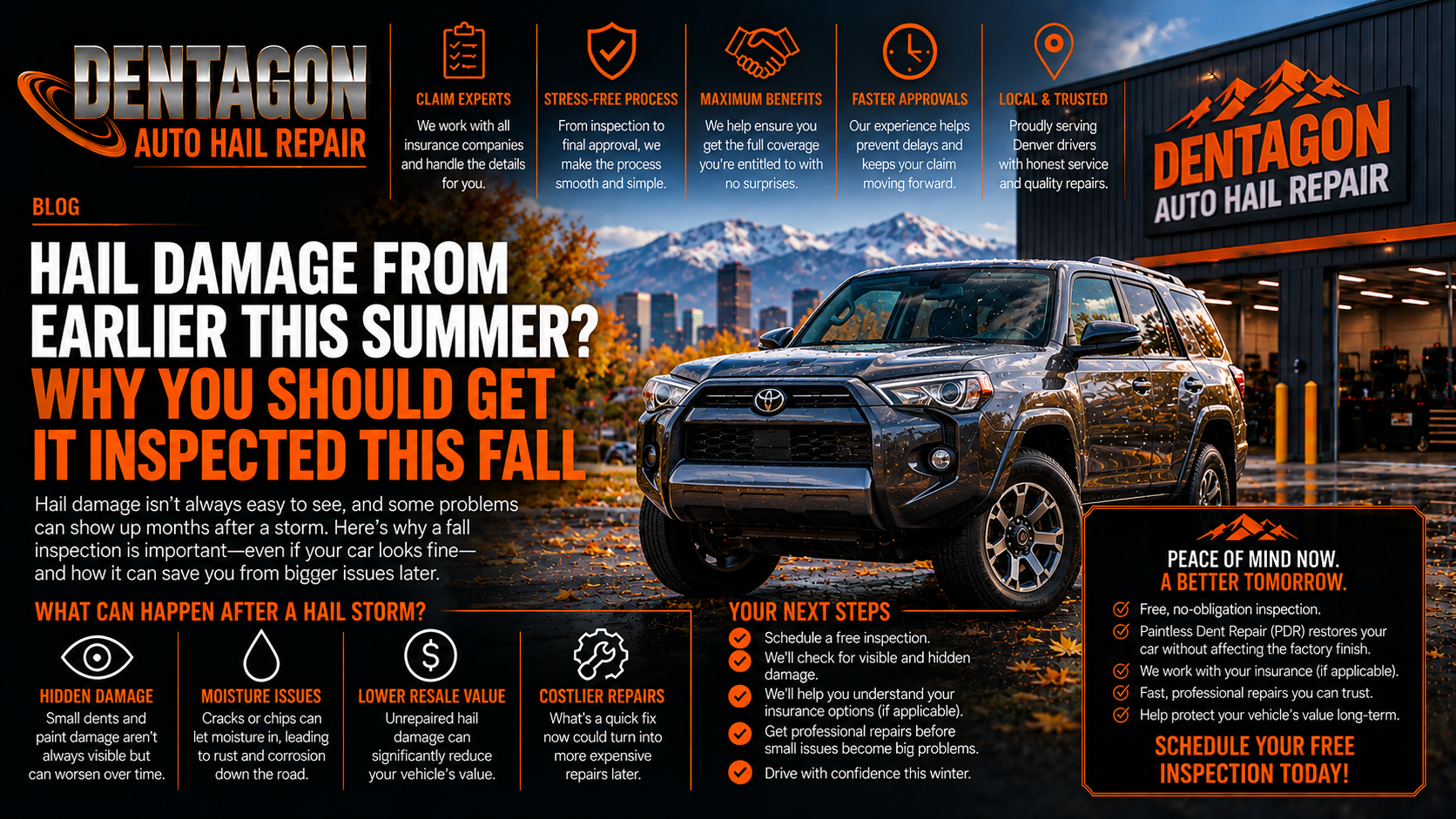
Hail Damage From Earlier This Summer? Why You Should Get It Inspected This Fall
Still Have Hail Damage From a Spring or Summer Storm?
If your vehicle was damaged by hail earlier this year and you haven’t done anything about it yet, you’re not alone.
Colorado’s hail season can produce multiple storms across the Denver metro area, and not every driver immediately schedules an inspection or files an insurance claim.
Sometimes the damage doesn’t look that bad.
Sometimes life gets busy.
And sometimes drivers simply aren’t sure what they’re supposed to do next.
By the time fall arrives, the storm may have happened several months ago—but the hail damage hasn’t disappeared.
If you can see dents across your hood, roof, trunk, or other body panels, or you know your vehicle was caught in a significant hailstorm but aren’t sure whether it was damaged, fall is a good time to have it professionally inspected.
Dentagon Auto Hail Repair offers FREE hail damage inspections for drivers throughout Denver and the surrounding metro area.
Why Is Hail Damage So Easy to Ignore?
Automotive hail damage is different from many other types of vehicle damage.
A collision may make a vehicle undrivable.
A broken windshield demands immediate attention.
A flat tire can’t simply be ignored.
Hail damage can be different.
Your vehicle may have dozens of dents and still:
• Start normally
• Drive normally
• Have no warning lights
• Have no mechanical problems
• Look relatively normal from certain angles
That makes it easy to postpone dealing with the damage.
But just because the vehicle drives normally doesn’t mean there isn’t significant cosmetic damage.
Can My Car Have Hail Damage I Can’t Easily See?
Yes.
Hail dents can be surprisingly difficult to see under normal lighting.
Walk around a vehicle on an overcast day and you may only notice a handful of dents.
Move the same vehicle under specialized Paintless Dent Repair lighting and considerably more damage may become visible.
Professional PDR lighting creates controlled reflections across the vehicle’s panels, helping technicians identify subtle changes in the metal.
Damage may be present on:
• Hood
• Roof
• Trunk or liftgate
• Doors
• Fenders
• Quarter panels
• Roof rails
• Other exterior panels
That’s why looking at your vehicle in the driveway isn’t always enough to determine how much hail damage actually occurred.
Why Should I Get Hail Damage Inspected in the Fall?
Fall creates a natural opportunity to deal with damage left over from spring and summer storms.
By this point, you know the dents aren’t going away on their own.
Having the vehicle inspected can help determine:
• Which panels were damaged
• How extensive the damage is
• Whether the factory paint remains intact
• Whether Paintless Dent Repair may be appropriate
• Whether some areas require conventional repair
• Whether an existing insurance estimate appears to reflect the visible damage
• What repair options are available
An inspection doesn’t mean you’re automatically committing to repairs.
It gives you information.
Once you understand the extent of the damage, you can make a more informed decision about what to do next.
Do Hail Dents Go Away on Their Own?
Generally, no.
Automotive body panels don’t normally return to their original shape simply because several weeks or months have passed.
Temperature changes may cause metal to expand and contract slightly, but you shouldn’t expect normal seasonal temperature changes to professionally restore hail damage.
Be skeptical of claims that simply parking a hail-damaged vehicle in the sun will reliably remove the dents.
Proper Paintless Dent Repair requires specialized tools, lighting, training, and techniques to carefully manipulate damaged metal back toward its original shape.
What Happens If I Leave Hail Damage Unrepaired?
The answer depends on the damage.
If the hail caused shallow dents while leaving the factory paint completely intact, the primary issue may remain cosmetic.
If an impact chipped or cracked the paint, however, the situation may be different.
Automotive paint helps protect the underlying metal.
When that protective finish is compromised and metal becomes exposed, moisture can potentially contribute to corrosion over time.
There are other reasons you may eventually want to address unrepaired hail damage as well.
It can affect:
• Vehicle appearance
• Potential resale value
• Trade-in offers
• Lease-return condition
• Documentation if the vehicle is damaged by another hailstorm
The important thing is knowing what kind of damage your vehicle actually has.
Is Old Hail Damage Harder to Repair?
The age of the hail damage by itself doesn’t necessarily determine whether Paintless Dent Repair is possible.
Technicians are generally more concerned with characteristics such as:
• Dent depth
• Dent size
• Dent location
• Panel material
• Paint condition
• Accessibility behind the panel
• Previous repairs
• Sharpness of the impact
• Whether the metal has been excessively stretched
A dent that occurred several months ago may still be repairable with PDR if the damage otherwise qualifies.
Don’t assume that you’ve missed your opportunity simply because the storm happened earlier in the year.
Have the vehicle inspected.
What Is Paintless Dent Repair?
Paintless Dent Repair, commonly known as PDR, is a specialized repair method used to restore many types of dents without sanding, body filler, or repainting.
Technicians use specialized tools and techniques to carefully reshape the damaged metal while preserving the vehicle’s existing factory finish whenever possible.
PDR is commonly used for:
• Hail dents
• Door dings
• Minor dents
• Shallow creases
• Hood dents
• Roof dents
• Trunk dents
• Fender dents
• Quarter-panel dents
When hail damage qualifies for PDR, the vehicle may be restored without many of the procedures associated with conventional body repair.
Learn more about our Paintless Dent Repair services.
Why Is Preserving the Factory Paint Important?
Your vehicle’s factory finish was applied under highly controlled manufacturing conditions.
One of the major advantages of Paintless Dent Repair is that qualifying damage can often be repaired without disturbing that original finish.
PDR generally eliminates the need for:
• Body filler
• Sanding
• Primer
• Repainting
• Paint blending
• Clear-coat refinishing
That means there are no paint-matching concerns on a panel that can be successfully restored with PDR.
For drivers who care about maintaining as much of their vehicle’s original condition as possible, that’s an important benefit.
Can PDR Repair Hundreds of Hail Dents?
Potentially.
The number of dents doesn’t automatically determine whether a vehicle qualifies for Paintless Dent Repair.
Colorado hailstorms can leave vehicles with dozens or even hundreds of dents across multiple panels.
A technician evaluates the characteristics of those dents and the condition of the panels to determine whether PDR is appropriate.
Some extensively damaged vehicles can still be excellent PDR candidates.
Other vehicles may have fewer dents but require conventional repair because of paint damage, severely stretched metal, inaccessible damage, or other factors.
Every vehicle needs to be evaluated individually.
What If I Didn’t Notice the Damage Until Weeks Later?
That can happen.
Hail damage isn’t always obvious immediately after a storm.
Lighting conditions, dirt, vehicle color, dent size, and the angle from which you view the vehicle can all affect how noticeable the damage appears.
You may wash your vehicle several weeks later and suddenly notice dents you hadn’t seen before.
Or you may park beneath bright lights and realize the roof or hood has significantly more damage than you thought.
If you believe the damage came from an earlier hailstorm, be accurate when communicating with your insurance company.
Don’t invent a storm date.
Review your records and contact your insurer regarding the requirements that apply to your policy and situation.
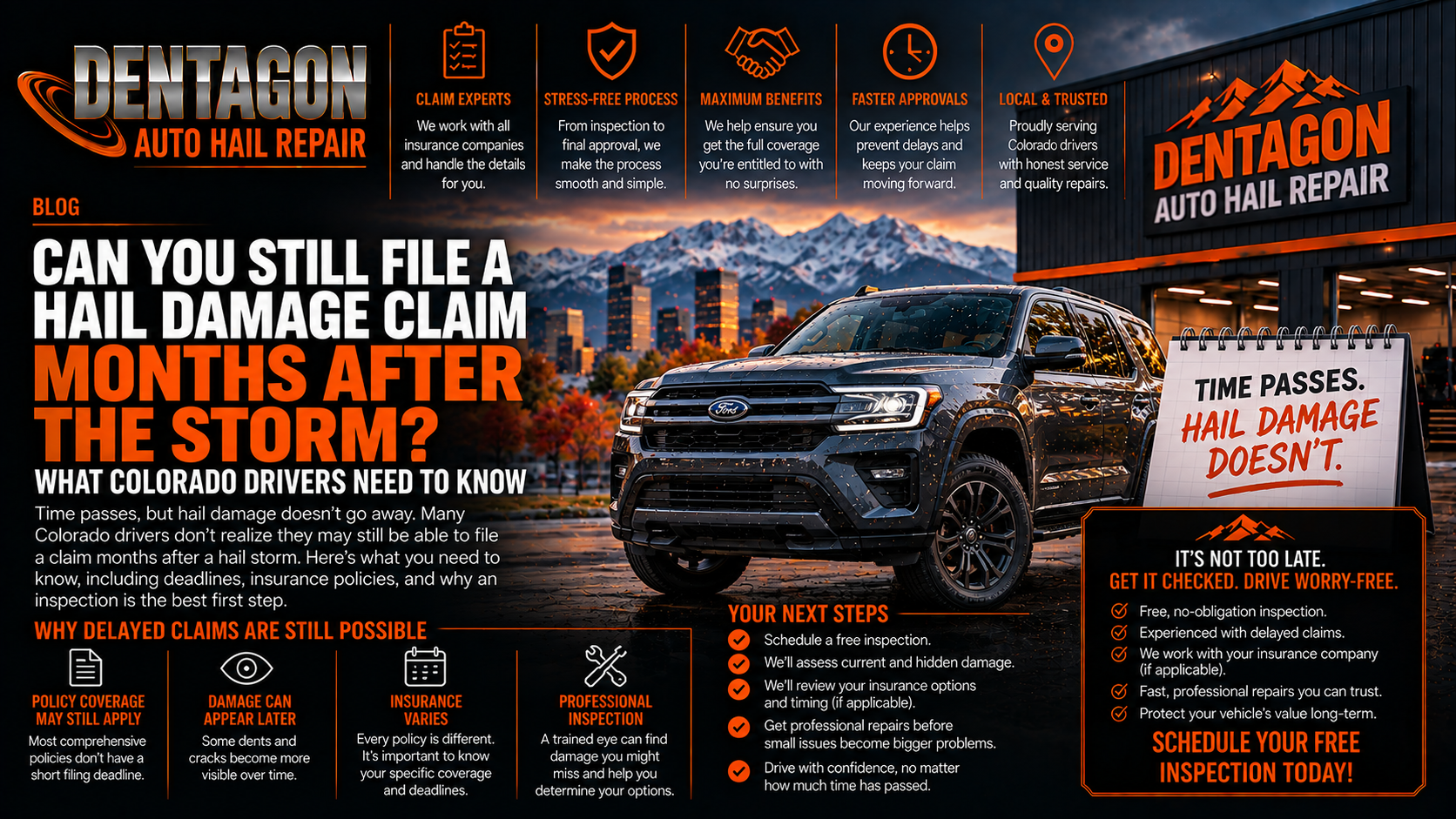
Can I Still File an Insurance Claim Months After a Hailstorm?
Possibly, but you shouldn’t assume a universal deadline applies to every insurance policy.
Hail damage is commonly handled under comprehensive auto insurance, subject to the policy’s deductible, exclusions, limits, reporting requirements, and other terms.
If your vehicle was damaged earlier this year and you haven’t filed a claim, review your policy or contact your insurance company.
Tell them accurately what happened and when you believe the loss occurred.
Your insurance carrier can explain whether coverage applies and what documentation it requires.
We’ll cover delayed hail claims in greater detail in another article, but the important point is simple:
Don’t assume it’s automatically too late without checking.
What Information Should I Have Before Contacting My Insurance Company?
If you believe your vehicle was damaged during an earlier hailstorm, gather as much accurate information as possible.
Useful information may include:
• Insurance policy information
• Approximate date of the storm
• Location where the vehicle was when the storm occurred
• Photographs of the damage
• Photographs taken around the time of the storm, if available
• Any previous insurance estimates
• Existing claim information
If you’re uncertain about something, say that you’re uncertain.
Accuracy is more important than trying to fill in missing information.
What If I Already Have an Insurance Estimate?
Bring it to your inspection.
An initial insurance estimate may not necessarily represent the final repair cost.
Hail dents can be difficult to identify without specialized PDR lighting, and some damage or necessary repair procedures may become apparent during a more detailed repair-facility inspection.
If additional covered damage or necessary repair operations are identified, the repair facility may be able to submit supplemental documentation to the insurance company for review.
Dentagon can help with:
• Reviewing insurance estimates
• Documenting hail damage
• Communicating with insurance adjusters
• Supplemental estimates when additional covered damage is identified
• Repair documentation
• Explaining the repair process
Learn more about our Insurance Claims Assistance program.
What If My Insurance Estimate Seems Too Low?
Don’t assume the initial estimate is necessarily the final amount available for a covered repair.
Insurance estimates are based on the damage identified during the insurer’s inspection and the repair procedures included at that time.
Once a repair facility performs a detailed inspection, additional covered damage or required operations may sometimes be identified.
This is where the supplemental estimate process can become important.
A supplement is additional documentation submitted to the insurance company for review when covered damage or necessary repair procedures weren’t included in the original estimate.
It isn’t about artificially increasing a repair bill.
It’s about accurately documenting the work necessary to properly repair covered damage.
What If I’ve Already Received an Insurance Check?
Receiving an insurance payment doesn’t necessarily mean you’ve completed the repair process.
If you haven’t repaired the vehicle yet, bring the insurance estimate and related claim documentation to your inspection.
Dentagon can review the repair-related information and compare it with the damage identified during the vehicle inspection.
If additional covered damage is discovered, supplemental documentation may be submitted to the insurer for consideration when appropriate.
Don’t assume the number printed on the first insurance check automatically represents the complete cost of restoring the vehicle.
What About My Comprehensive Deductible?
Your comprehensive deductible is the amount specified by your insurance policy that you’re generally responsible for on a covered comprehensive claim.
For some drivers, the deductible is one reason hail damage remains unrepaired months after the storm.
Dentagon offers Deductible Assistance for qualifying repairs.
Eligibility depends on the circumstances of the repair and claim, so not every vehicle or repair automatically qualifies.
Ask about available deductible assistance when scheduling your free inspection.
What If My Vehicle Was Hit by More Than One Hailstorm?
This is one reason documenting hail damage matters.
Colorado can experience multiple hailstorms during the same season.
If your vehicle was damaged in one storm, left unrepaired, and then damaged again during another storm, determining which damage occurred during which event may become more complicated.
Separate hailstorms may also represent separate loss events for insurance purposes.
Be accurate with your insurance company about the circumstances surrounding each event.
If your vehicle already has unrepaired hail damage, having it inspected and documented can help establish its current condition.
Can I Wait Until Next Spring to Repair It?
You can choose when to repair your vehicle, but waiting another six months doesn’t provide much benefit if you already know the vehicle is damaged.
During that time:
• The damage remains visible
• Damaged paint may remain exposed
• You may decide to sell or trade the vehicle
• A lease may approach its return date
• Another weather event could damage the vehicle
• Documentation may become more complicated
At minimum, consider getting the damage inspected now.
You can then make your decision based on the actual condition of the vehicle rather than simply postponing it because you’re unsure what the repair involves.
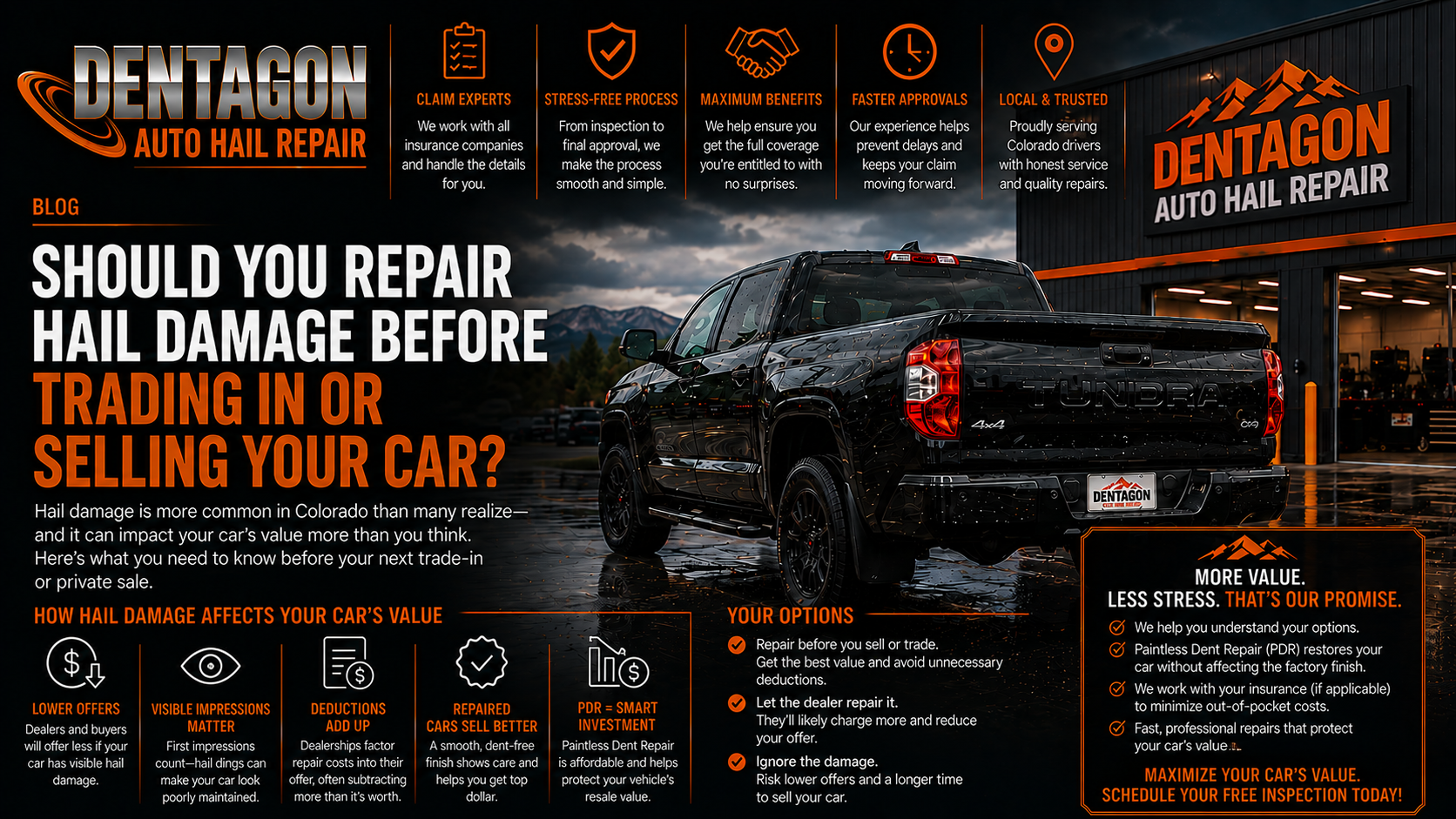
What If I’m Planning to Sell or Trade My Vehicle?
Unrepaired hail damage can affect how a dealership or private buyer evaluates a vehicle.
Even when the damage is cosmetic and the vehicle operates perfectly, exterior condition matters.
A dealership may account for potential repair costs when calculating its trade-in offer.
A private buyer may see dents in photographs and immediately expect a discount.
Before accepting less for your vehicle because of hail damage, find out what repairing it would involve.
A professional inspection gives you information you can use when deciding whether to repair the vehicle first or sell it as-is.
What If My Vehicle Is Leased?
If you’re driving a leased vehicle with unrepaired hail damage, review your lease agreement and return-condition requirements.
Hail damage may potentially be considered beyond normal wear and tear.
The exact requirements depend on your leasing company and agreement.
If your lease ends later this year or early next year, don’t wait until the lease-return inspection to investigate the hail damage.
Getting it inspected this fall gives you more time to understand your insurance coverage and repair options.
Why Fall Is a Smart Time to Finally Deal With Hail Damage
Once summer ends, it’s easy to mentally move on from hail season.
But your vehicle hasn’t.
Those dents from May, June, July, or August are still there.
Fall gives you an opportunity to:
• Determine the actual extent of the damage
• Document the vehicle’s current condition
• Find out whether PDR is appropriate
• Review an existing insurance estimate
• Ask questions about the repair process
• Address deductible concerns
• Plan repairs before another hail season
And it starts with something simple:
A professional inspection.
Why Choose Dentagon for Your Hail Damage Inspection?
Dentagon Auto Hail Repair specializes in automotive hail damage and Paintless Dent Repair.
We’ll inspect your vehicle and explain what we find so you can make an informed decision about repairing it.
Drivers choose Dentagon for:
✓ Free Hail Damage Inspections
✓ Paintless Dent Repair Specialists
✓ Insurance Claims Assistance
✓ Deductible Assistance for Qualifying Repairs
✓ Lifetime Warranty
✓ Honest Recommendations
✓ Exceptional Customer Service
Our goal isn’t to pressure every customer into a repair.
It’s to help you understand the damage, available repair options, and repair-related insurance process so you can decide what makes sense for your vehicle.
Serving Denver and Surrounding Communities
Dentagon provides professional hail damage inspections and Paintless Dent Repair throughout the Denver metro area, including:
• Arvada
• Aurora
• Brighton
• Broomfield
• Castle Rock
• Centennial
• Denver
• Englewood
• Highlands Ranch
• Lakewood
• Littleton
• Parker
• Westminster
Whether your vehicle was damaged last week or several months ago, our team can inspect the damage and help you understand your next step.
Schedule Your Free Fall Hail Damage Inspection
If your vehicle still has hail damage from earlier this spring or summer, don’t keep wondering how bad it is or what repairing it might involve.
Find out.
Dentagon Auto Hail Repair can professionally inspect your vehicle, determine whether Paintless Dent Repair is appropriate, explain your repair options, review existing insurance repair documentation, and assist with the repair-related insurance process when applicable.
The inspection is free, and it gives you the information you need to decide what to do next.
Schedule your FREE hail damage inspection today.