

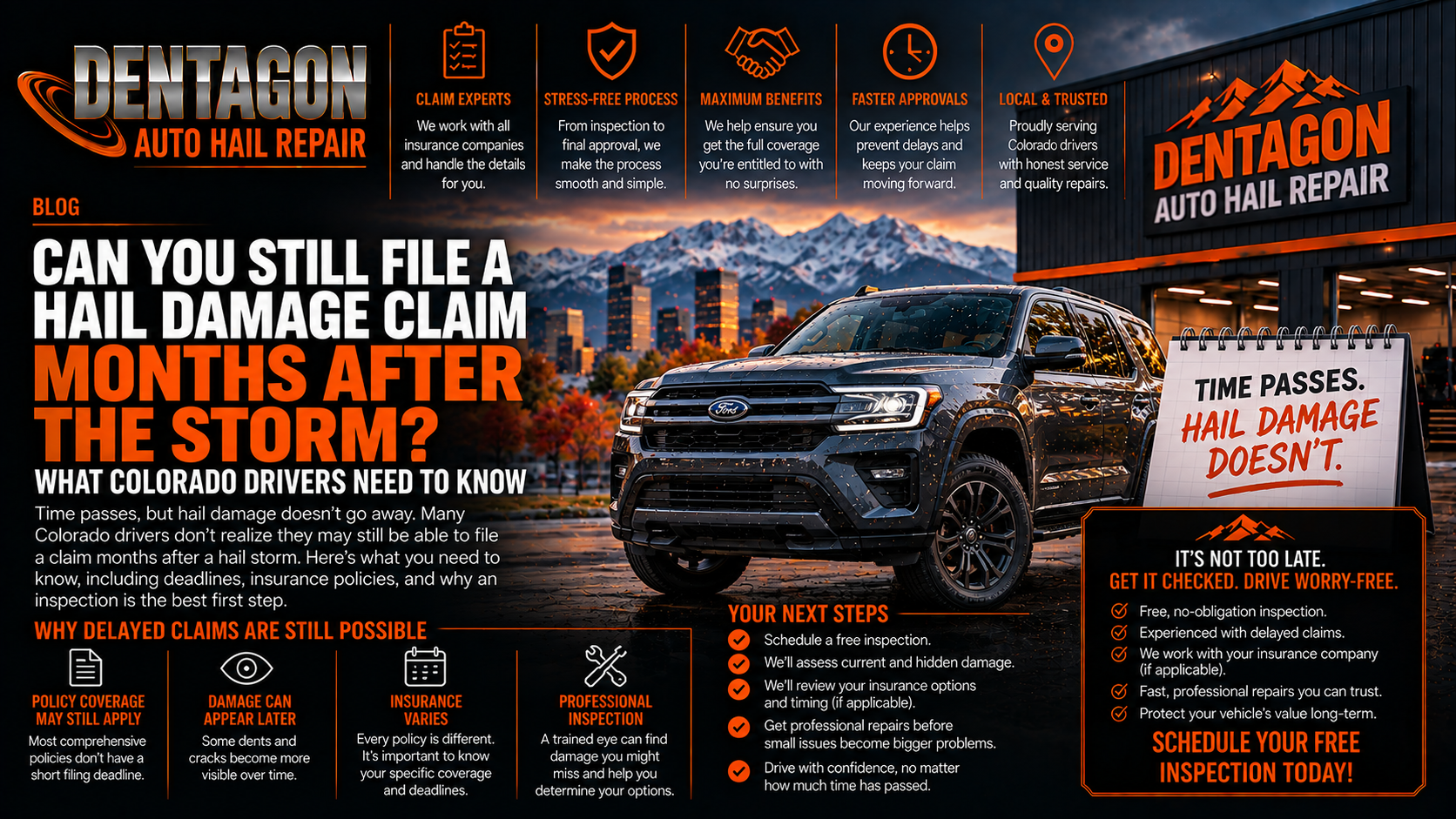
Can You Still File a Hail Damage Claim Months After the Storm? What Colorado Drivers Need to Know
Is It Too Late to File a Hail Damage Claim?
You walk outside, look across the hood of your vehicle, and notice the dents are still there from a hailstorm earlier this year.
Maybe the storm happened in May.
Maybe June or July.
At the time, the damage didn’t seem severe enough to deal with immediately. Your vehicle drove normally, the windshield wasn’t broken, and life moved on.
Now several months have passed and you’re wondering:
Can I still file an insurance claim for the hail damage?
Possibly.
The important thing is not to assume that you’ve automatically waited too long.
Insurance policies can have different requirements regarding when damage must be reported, how claims are documented, and what information the insurance company needs.
If your vehicle was damaged during an earlier Colorado hailstorm, review your policy and contact your insurance carrier to determine what applies to your specific situation.
And before deciding the damage isn’t worth addressing, consider having the vehicle professionally inspected.
Dentagon Auto Hail Repair offers FREE hail damage inspections for drivers throughout Denver and the surrounding metro area.
How Long Do You Have to File a Hail Damage Claim in Colorado?
There isn’t one universal claim-reporting deadline that applies to every driver, insurance company, and auto policy.
Your specific insurance policy matters.
Policies may contain requirements regarding how quickly a loss should be reported and what documentation may be required.
That’s why you shouldn’t rely on a generic deadline you found online.
If your vehicle was damaged several months ago:
• Review your auto insurance policy
• Locate your comprehensive coverage information
• Identify the approximate storm date
• Determine where the vehicle was during the storm
• Photograph the current damage
• Contact your insurance company
• Ask what requirements apply to your policy
Most importantly, be accurate.
Don’t change or guess the date of loss simply because time has passed.
Does Auto Insurance Cover Hail Damage?
Hail damage is commonly covered when a vehicle has comprehensive auto insurance, subject to the policy’s deductible, exclusions, limits, and other terms.
Comprehensive coverage generally applies to certain types of vehicle damage that aren’t caused by a collision.
That can include events such as:
• Hail
• Windstorms
• Falling objects
• Theft
• Vandalism
• Certain animal-related damage
However, having auto insurance doesn’t automatically mean you have comprehensive coverage.
Liability coverage by itself generally doesn’t pay to repair hail damage to your own vehicle.
If you’re unsure what coverage you had when the storm occurred, review your policy or contact your insurance carrier.
What If I Didn’t Notice the Hail Damage Right Away?
That happens more often than many drivers realize.
Automotive hail damage can be difficult to see under ordinary lighting.
You may look at your vehicle immediately after a storm and notice only a few dents.
Then several weeks later, you park beneath bright lights or wash the vehicle and suddenly see dents covering the hood or roof.
Factors that can affect how noticeable hail damage appears include:
• Vehicle color
• Lighting
• Viewing angle
• Dent depth
• Dent diameter
• Dirt on the vehicle
• Location of the damage
Professional Paintless Dent Repair lighting is designed to create controlled reflections across a vehicle’s panels, making subtle dents easier to identify.
So if you didn’t recognize the extent of the damage immediately after the storm, you’re not necessarily the only one.
What If I Don’t Remember the Exact Date of the Hailstorm?
Don’t invent one.
If you aren’t certain about the date, gather whatever accurate information you have.
You may be able to narrow down the timing by reviewing:
• Photographs on your phone
• Text messages
• Calendar entries
• Weather information
• Receipts showing where you were
• Previous conversations about the storm
• Insurance correspondence
If you still aren’t certain, tell your insurance company what you actually know.
Your insurer can explain what information it requires to evaluate the claim.
Accuracy is much better than guessing.
Why Does the Date of the Hailstorm Matter?
Insurance claims are associated with a specific loss event.
The date of loss helps establish which policy was active, what coverage applied, and which weather event caused the reported damage.
This can become especially important if:
• You’ve changed insurance companies
• Your coverage has changed
• Your deductible changed
• You’ve purchased or sold the vehicle
• The vehicle was damaged by more than one storm
• You’ve previously filed another hail claim
That’s why accurately identifying the storm matters.
If you aren’t sure, don’t simply select a convenient date.
Can Dentagon Tell Me Which Storm Damaged My Vehicle?
Dentagon can inspect your vehicle and document the hail damage we identify.
However, a repair facility shouldn’t invent a date of loss for you.
If several hailstorms occurred in your area and you don’t know which one damaged the vehicle, that’s something you should discuss accurately with your insurance carrier.
We can help you understand the physical damage and repair process.
Your insurance company determines coverage under your policy.
Should I Get the Vehicle Inspected Before Filing a Claim?
A professional hail inspection can be extremely useful because it helps you understand what damage actually exists.
An inspection can help identify:
• Damaged panels
• Approximate dent severity
• Areas with subtle damage
• Condition of the factory paint
• Whether Paintless Dent Repair may be appropriate
• Areas that may require another repair method
However, an inspection doesn’t replace your insurance company’s claim process.
If you’re considering filing a claim, contact your insurance carrier and follow the reporting requirements associated with your policy.
Dentagon can then assist with the repair-related portion of the process.
What Information Do I Need to Start a Hail Damage Claim?
Your insurance company will tell you exactly what it requires, but it’s helpful to have basic information available before contacting them.
That may include:
• Your name and contact information
• Insurance company
• Policy number
• Vehicle year, make, and model
• Approximate date of loss
• Location where the vehicle was damaged
• Description of what happened
• Photographs of the damage
• Any previous claim information
If you’ve already had the vehicle inspected, you may also have additional documentation showing the extent of the damage.
Keep copies of any information you provide or receive.
What Happens After I File a Hail Damage Claim?
The exact process varies by insurance company.
Generally, the insurer will create a claim and determine how it wants the vehicle inspected.
That could involve an adjuster, inspection location, photo-based estimate, or another process used by the insurance carrier.
The insurer may then prepare an initial repair estimate based on the damage it identified.
Remember:
The initial insurance estimate may not necessarily be the final repair cost.
That’s especially relevant with hail damage because subtle dents can be difficult to identify without specialized lighting.
What If the Insurance Estimate Misses Some of the Hail Damage?
This is where the supplemental estimate process can become important.
A repair facility may perform a more detailed inspection and identify additional covered damage or necessary repair procedures that weren’t included in the original insurance estimate.
When appropriate, supplemental documentation can be submitted to the insurance company for review.
A supplement may include items such as:
• Additional damaged panels
• Additional dents
• Necessary removal and installation procedures
• Required parts
• Repair operations
• Other covered procedures necessary to complete the repair
The insurance company reviews the supplemental information and determines whether the additional items are covered.
Dentagon can help with the repair-related documentation and communication involved in that process.
What If I’ve Already Received an Insurance Check?
Receiving an insurance payment doesn’t necessarily mean the repair process is complete.
The payment may be based on the insurer’s initial estimate.
If the vehicle hasn’t been professionally inspected by a hail repair facility yet, additional covered damage or necessary repair procedures may potentially be identified.
Bring your insurance estimate and claim information to Dentagon.
We can compare the repair-related documentation with the damage identified during our inspection and explain what happens next.
If additional covered damage is discovered, supplemental documentation may be submitted to the insurance company for consideration when appropriate.
What If the Insurance Check Is Less Than the Repair Cost?
Don’t automatically assume you must personally pay the entire difference.
First determine why the repair estimate differs.
If the repair facility identifies additional covered damage or necessary repair procedures that weren’t included in the insurer’s initial estimate, it may be possible to submit a supplement for review.
That doesn’t guarantee that every requested item will be approved.
The insurance company ultimately determines what is covered under the policy.
But an initial estimate isn’t necessarily the end of the repair process.
What Is Paintless Dent Repair?
Paintless Dent Repair, commonly called PDR, is a specialized method used to restore many types of automotive dents while preserving the original factory finish whenever possible.
Instead of sanding the damaged panel, applying body filler, and repainting it, technicians use specialized tools and techniques to carefully reshape the metal.
PDR is commonly used to repair:
• Hail dents
• Door dings
• Minor dents
• Shallow creases
• Hood dents
• Roof dents
• Trunk dents
• Fender dents
• Quarter-panel dents
A vehicle may have dozens or even hundreds of hail dents and still potentially qualify for Paintless Dent Repair.
Learn more about our Paintless Dent Repair services.
Why Is PDR Commonly Used for Hail Damage?
Hail often creates numerous relatively shallow dents while leaving the factory paint intact.
Those characteristics can make many hail-damaged vehicles good candidates for PDR.
When the damage qualifies, PDR generally avoids:
• Body filler
• Sanding
• Primer
• Repainting
• Paint blending
• Clear-coat refinishing
This allows the repair to preserve the vehicle’s original factory finish.
However, not every hail dent qualifies.
Paint damage, severely stretched metal, dent location, previous repairs, panel accessibility, and other factors can affect the appropriate repair method.
That’s why an inspection is necessary.
Will Insurance Pay for Paintless Dent Repair?
When hail damage is covered under a comprehensive claim and PDR is an appropriate repair method, the insurance estimate may include Paintless Dent Repair.
The exact repair procedures and coverage depend on the damage, insurer’s estimate, policy terms, and approved repair plan.
Your insurance company determines coverage.
Dentagon determines the repair procedures we believe are appropriate for restoring the vehicle.
When differences exist between an initial insurance estimate and the repair requirements identified during the repair process, supplemental documentation may be submitted for review.
What About My Comprehensive Deductible?
Your comprehensive deductible is the amount specified in your policy that you’re generally responsible for on a covered comprehensive claim.
For example, if your policy has a $500 comprehensive deductible, that deductible generally applies according to the terms of your policy regardless of when the repair is completed.
Waiting several months doesn’t automatically eliminate your deductible.
Dentagon offers Deductible Assistance for qualifying repairs.
Eligibility depends on the repair and claim circumstances, so not every customer or repair automatically qualifies.
Ask our team about available deductible assistance when you schedule your inspection.
Can I File a Claim After Changing Insurance Companies?
This situation can be more complicated, which is another reason the actual date of loss matters.
Insurance coverage generally relates to the policy that was in effect when the covered loss occurred.
If the hailstorm happened while you were insured by a previous company, changing insurers afterward doesn’t automatically transfer responsibility for the earlier damage to your new carrier.
Contact the insurance company that covered the vehicle at the time of the storm and accurately explain the situation.
The insurer will determine whether the claim qualifies under the policy that was active at that time.
What If My Vehicle Was Hail Damaged More Than Once?
Colorado vehicles can experience multiple hailstorms during the same season.
If your vehicle was damaged during one storm and then hit again during another storm before the original damage was repaired, things can become more complicated.
Separate storms may represent separate loss events.
That can potentially mean:
• Different dates of loss
• Separate claims
• Separate damage documentation
• Different coverage circumstances
• Separate deductibles depending on the policy and claims
Don’t combine damage from separate storms into one event simply because the dents look similar.
Be accurate with your insurer about what happened.
Can an Insurance Company Tell Old Hail Damage From New Hail Damage?
There isn’t a simple method that can precisely date every individual dent.
However, insurers and repair professionals may consider multiple factors when evaluating damage and claim circumstances.
That’s another reason documentation matters.
Photographs, prior estimates, repair records, previous claims, storm information, and inspections can all help establish the vehicle’s condition at different points in time.
If you already have hail damage, don’t wait for another storm and assume everything can simply be handled together later.
What If I Bought the Vehicle With Existing Hail Damage?
Insurance is generally intended to cover losses that occur during the period when the applicable coverage is in force.
Damage that existed before you purchased the vehicle or before your coverage became effective presents a different situation from damage caused by a storm while you owned and insured it.
Don’t attempt to claim pre-existing damage as if it happened during a recent storm.
If you purchased a vehicle with hail damage and want to have it repaired, Dentagon can still inspect the vehicle and explain potential repair options.
But insurance coverage for pre-existing damage is a separate issue that should be discussed accurately with your insurer.
Will Filing a Hail Claim Affect My Insurance Rates?
There isn’t one answer that applies to every driver.
Hail claims are generally comprehensive claims rather than at-fault collision claims.
However, insurance premiums are determined using numerous factors that can include:
• Insurance company
• Location
• Vehicle
• Coverage
• Claims history
• Regional loss experience
• Broader insurance market conditions
Dentagon doesn’t determine your insurance premium and shouldn’t promise that filing a hail claim will—or won’t—affect your rate.
If you’re concerned about your specific policy, ask your insurance company.
What If My Hail Damage Is Only Cosmetic?
Most automotive hail damage is cosmetic.
But cosmetic doesn’t necessarily mean unimportant.
Visible dents can affect:
• Vehicle appearance
• Resale value
• Trade-in offers
• Lease-return condition
• Your ability to distinguish future hail damage from existing damage
The damage also needs to be inspected to determine whether the paint remains intact.
If hail impacts chipped or cracked the paint and exposed metal, the situation may deserve additional attention.
A professional inspection helps determine exactly what you’re dealing with.
Is It Worth Filing a Claim for Minor Hail Damage?
That depends on your particular situation.
Consider:
• Extent of the damage
• Vehicle value
• Comprehensive coverage
• Deductible
• Repair options
• Paint condition
• Whether multiple panels are damaged
What appears to be minor damage in your driveway may also look different under professional PDR lighting.
Before deciding the damage isn’t significant enough to address, consider having it professionally inspected.
Then you can compare the actual damage and potential repair options with your insurance coverage and deductible.
Don’t Assume It’s Too Late Because Summer Is Over
This is probably the most important takeaway.
If your vehicle was damaged by hail earlier this year, don’t automatically assume that September, October, or even later means you’ve missed your opportunity to address it.
At the same time, don’t assume there’s an unlimited amount of time to report the loss.
Your insurance policy and circumstances matter.
Review your policy.
Contact your insurance carrier.
Be accurate about when the damage occurred.
And get the vehicle professionally inspected so you know how extensive the damage actually is.
Why Choose Dentagon for Your Hail Damage Claim and Repair?
Dentagon Auto Hail Repair specializes in automotive hail damage and Paintless Dent Repair.
We can inspect your vehicle, document the damage, explain your repair options, and assist with the repair-related portion of qualifying insurance claims.
Dentagon can help with:
✓ Free Hail Damage Inspections
✓ Paintless Dent Repair
✓ Insurance Claims Assistance
✓ Insurance Estimate Reviews
✓ Supplemental Repair Documentation
✓ Deductible Assistance for Qualifying Repairs
✓ Lifetime Warranty
✓ Honest Recommendations
✓ Exceptional Customer Service
We don’t determine whether your insurance company covers a claim.
Our job is to accurately identify the damage, properly repair your vehicle, and help navigate the repair-related insurance process when applicable.
Serving Denver and Surrounding Communities
Dentagon provides professional hail damage inspections and Paintless Dent Repair throughout the Denver metro area, including:
• Arvada
• Aurora
• Brighton
• Broomfield
• Castle Rock
• Centennial
• Denver
• Englewood
• Highlands Ranch
• Lakewood
• Littleton
• Parker
• Westminster
If your vehicle was damaged earlier this hail season, our team can inspect it and help you understand your repair options.
Schedule a Free Hail Damage Inspection
If you’re looking at hail dents from a storm that happened months ago and wondering whether you’ve waited too long, don’t make the decision based on an assumption.
Start by finding out how much damage your vehicle actually has.
Dentagon Auto Hail Repair can inspect your vehicle, determine whether Paintless Dent Repair is appropriate, review existing insurance repair documentation, and assist with the repair-related claim process when applicable.
Then contact your insurance company to determine the reporting and coverage requirements associated with your specific policy.
The sooner you understand your options, the easier it is to decide what to do next.
Schedule your FREE hail damage inspection today.