

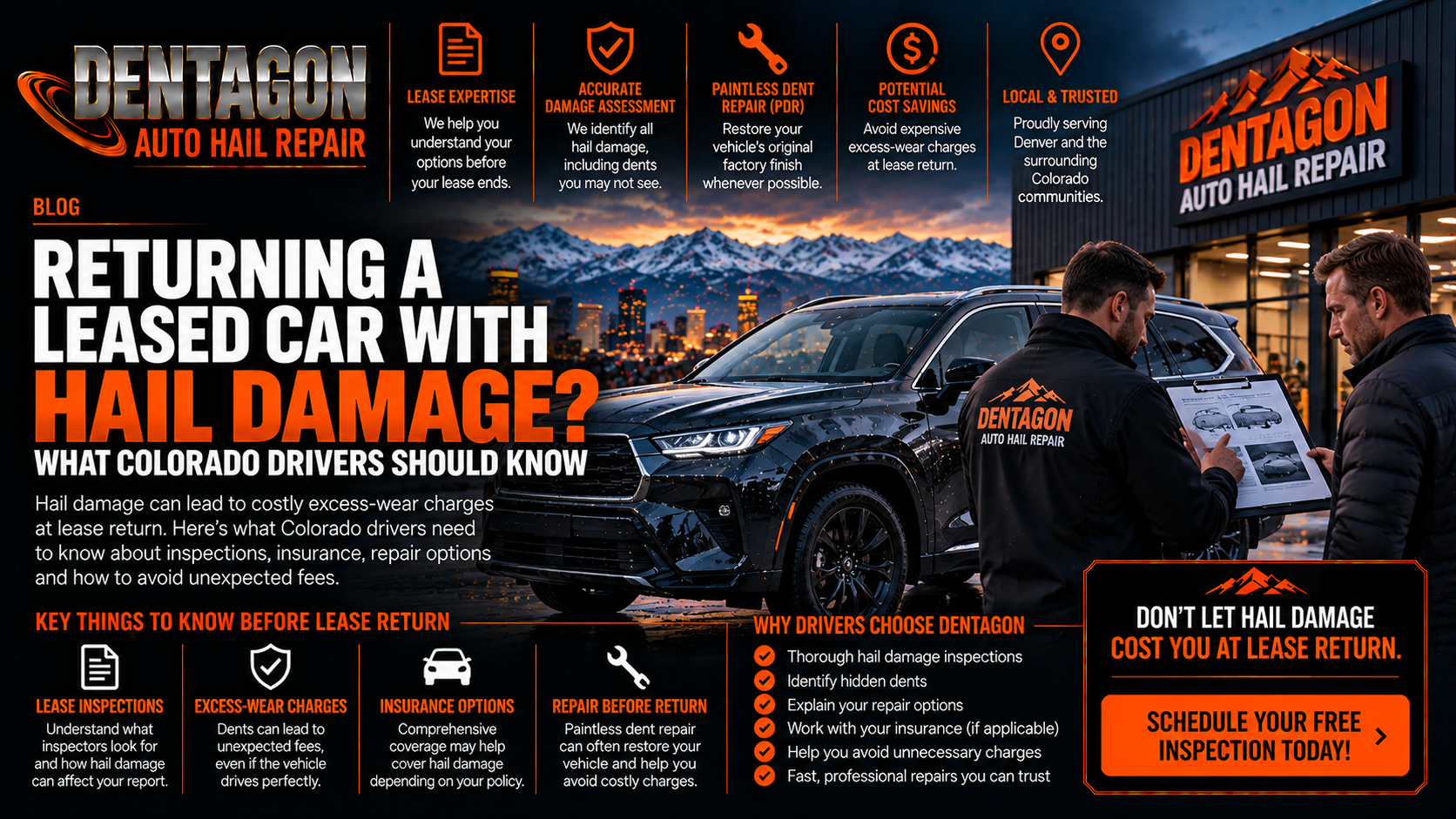
Returning a Leased Car With Hail Damage? What Colorado Drivers Should Know
Your lease is almost up. You’ve kept up with maintenance, avoided major accidents, and you’re getting ready to return your vehicle to the dealership. There’s just one problem: a Colorado hailstorm left dents across your hood, roof, or trunk.
Now you’re wondering whether you need to repair the damage before turning in the keys—or whether the leasing company will simply overlook a few dents.
Here’s what many Denver-area drivers don’t realize: hail damage can result in lease-end charges, even when the vehicle drives perfectly and the damage seems minor.
Leasing companies typically expect vehicles to be returned within established wear-and-tear guidelines. While minor cosmetic imperfections may be acceptable, hail dents often fall outside those allowances, depending on their size, number, and severity.
The good news? You may have options that can help you avoid unnecessary lease-end expenses.
At Dentagon, we specialize in automotive hail damage repair and Paintless Dent Repair (PDR) throughout the Denver metro area. If you’re approaching the end of your lease with hail damage, here’s what you should know before returning your vehicle.
Can You Return a Leased Car With Hail Damage?
Yes, you can generally return a leased vehicle with hail damage, but that doesn’t mean you won’t be charged for it.
Most automotive lease agreements establish standards for the vehicle’s condition when it’s returned. These standards distinguish between normal wear and tear and damage that may require additional payment.
Normal wear and tear might include minor surface scratches, small chips, or other cosmetic imperfections within the leasing company’s guidelines.
Hail damage is different.
A vehicle with multiple dents across its hood, roof, doors, or trunk may require repairs that exceed the leasing company’s acceptable condition standards.
If the damage falls outside those guidelines, you could face excess-wear charges when the vehicle is returned.
What Determines Whether You’ll Be Charged?
Several factors may influence how the leasing company evaluates hail damage:
-
Number of dents: Multiple small dents may be treated differently from a single isolated imperfection.
-
Dent size and depth: Larger or deeper dents are more likely to exceed acceptable wear limits.
-
Affected panels: Damage across multiple body panels can increase potential repair costs.
-
Paint condition: Cracked or chipped paint may require additional repairs.
-
Lease agreement: Every leasing company has its own return standards and damage assessment procedures.
The most important thing to understand is that your lease agreement—not a general rule about hail damage—determines your obligations.
Before assuming your vehicle is acceptable for return, review the leasing company’s wear-and-tear guidelines.
Is Hail Damage Considered Normal Wear and Tear on a Leased Car?
Usually, significant hail damage is not considered normal wear and tear.
Normal wear generally refers to the minor cosmetic deterioration that occurs through ordinary vehicle use.
Hail damage, however, results from an external weather event and may affect the vehicle’s condition and value.
Even if you did nothing wrong and had no way to prevent the storm, the leasing company may still require the damage to be addressed or charge you for it.
Why Small Hail Dents Can Still Matter
One or two shallow dents might not seem particularly concerning.
However, hailstorms rarely damage vehicles in perfectly isolated spots. A storm that leaves several visible dents on the hood may also create smaller dents on the roof, trunk, or upper door panels.
Those less noticeable dents can become an issue during a detailed lease-return inspection.
Professional inspectors may use lighting, reflections, and panel-by-panel assessments to identify damage that isn’t obvious during a casual walkaround.
This is one reason it’s worth having your vehicle inspected before the official lease-end evaluation.
What Happens During a Lease-End Vehicle Inspection?
Many leasing companies offer or require a vehicle inspection before the lease expires.
Depending on the leasing company, this inspection may occur at your home, workplace, dealership, or another designated location.
The purpose is to document the vehicle’s condition and identify damage that exceeds acceptable wear standards.
What Inspectors Typically Look For
A lease-end inspection may evaluate:
-
Exterior dents and body damage
-
Scratches, paint chips, and damaged finishes
-
Windshield and glass condition
-
Wheel and tire damage
-
Interior wear or damage
-
Missing equipment or accessories
-
Mileage exceeding the lease allowance
For vehicles exposed to hail, inspectors may pay particular attention to the hood, roof, trunk, and other horizontal surfaces.
Can a Lease-End Inspection Find Damage You Didn’t Notice?
Absolutely.
Shallow hail dents can be difficult to see in ordinary lighting.
Professional inspection methods can reveal subtle distortions in body panels, especially when multiple dents are clustered together.
A vehicle that looks relatively clean in your driveway may have more damage than you initially realized.
The better approach is to identify potential hail damage before the leasing company’s inspection—not after receiving an unexpected bill.
Should You Repair Hail Damage Before Returning a Leased Vehicle?
In many situations, repairing qualifying hail damage before returning a leased vehicle is worth considering.
However, the right decision depends on the extent of the damage, your insurance coverage, your deductible, the leasing company’s requirements, and the cost of repairs.
Why Repairing the Damage First May Make Sense
When you return a damaged vehicle, the leasing company may assess charges based on its damage evaluation and contractual policies.
You may have less flexibility over how those charges are calculated or which repair methods are considered.
Arranging a professional inspection before returning the vehicle gives you an opportunity to understand the damage and explore your repair options.
If the dents qualify for Paintless Dent Repair, they may be repairable without conventional body filler or repainting.
That can be particularly valuable when maintaining the vehicle’s original finish is important.
When Repairing the Damage Might Not Be Necessary
Not every cosmetic imperfection automatically results in a lease-end charge.
Your leasing company may allow certain minor dents within its wear-and-tear guidelines.
In some circumstances, the estimated cost of repairs may also exceed the potential charges associated with returning the vehicle as-is.
Before authorizing repairs, compare the actual options available to you.
A professional hail damage inspection, your lease-return standards, and your insurance policy can help you make that decision.
Does Car Insurance Cover Hail Damage on a Leased Vehicle?
Hail damage is generally covered under comprehensive auto insurance, provided your policy includes that coverage.
Most automotive leases require drivers to maintain comprehensive and collision coverage throughout the lease term, although specific insurance requirements vary.
Comprehensive coverage typically applies to non-collision events such as hailstorms, falling objects, theft, and certain weather-related damage.
If your leased vehicle sustains hail damage, your insurance company may cover eligible repairs, subject to your deductible, coverage limits, exclusions, and other policy conditions.
Do You Still Have to Pay Your Deductible?
Usually, yes.
For example, if your comprehensive deductible is $500 and your insurer approves a covered hail repair claim, you would generally be responsible for that deductible unless an applicable benefit or arrangement reduces your out-of-pocket cost.
Dentagon offers deductible assistance for qualifying repairs. Eligibility and available assistance depend on the circumstances, and any arrangement must comply with applicable insurance requirements.
Should You File a Claim Before Your Lease Ends?
If you discover hail damage near the end of your lease, contact your insurance company promptly to understand your reporting requirements and coverage.
Some policies contain deadlines or other conditions that may affect how claims are handled.
Waiting until after the vehicle is returned can complicate matters because you may no longer have access to the vehicle for inspections or repairs.
A professional damage assessment can help you understand what needs attention before you begin the claims process.
Can Paintless Dent Repair Fix Hail Damage on a Leased Car?
In many cases, Paintless Dent Repair is an excellent option for qualifying hail damage on leased vehicles.
PDR is a specialized repair method that carefully reshapes dented metal without requiring traditional body filler or repainting when the factory finish remains intact.
Technicians use specialized tools and controlled techniques to restore the affected panels as closely as possible to their original shape.
Why PDR Is Particularly Useful for Leased Vehicles
1. Preserves the Original Factory Paint
Factory paint is an important part of a vehicle’s appearance and finish.
When PDR is appropriate, it allows technicians to remove dents without unnecessarily disturbing that original paint.
2. Avoids Unnecessary Repainting
Traditional repairs may involve sanding, filling, priming, and repainting.
PDR can eliminate those steps for qualifying dents, reducing the need for refinishing work.
3. Can Repair Multiple Hail Dents
Hailstorms often leave numerous small dents across several body panels.
Experienced PDR technicians can address many qualifying dents individually, restoring the vehicle’s appearance without replacing otherwise repairable panels.
4. May Reduce Repair Time
Depending on damage severity, parts requirements, technician availability, and scheduling, PDR may be completed more quickly than conventional repairs.
This can be particularly helpful when your lease-return deadline is approaching.
Does Every Hail Dent Qualify for PDR?
No.
Paintless Dent Repair works best when the paint remains intact and the metal can be restored without conventional refinishing.
Extremely deep dents, sharp creases, stretched metal, or damaged paint may require other repair methods.
A professional inspection is the best way to determine which dents are suitable for PDR.
What If Your Lease Ends Before the Hail Damage Can Be Repaired?
Timing can become a challenge when a hailstorm occurs shortly before your scheduled lease return.
During periods of widespread storm damage, repair facilities may experience increased demand, and insurance inspections can take additional time.
If your lease expires soon, don’t assume you’ll automatically receive an extension.
Contact Your Leasing Company
Ask whether an extension or alternative return arrangement is available.
Some leasing companies may offer options depending on your account status and contract, but extensions are not guaranteed.
Schedule a Damage Inspection Immediately
Understanding the extent of the damage helps you determine whether repairs can reasonably be completed before your return date.
It also gives you useful information when communicating with your insurer or leasing company.
Keep Documentation of the Damage and Repair Process
Save relevant records, including inspection findings, insurance correspondence, repair estimates, and completed repair invoices.
If questions arise during the return process, having accurate documentation can help clarify what happened and what work was performed.
Don’t Ignore the Return Deadline
A pending insurance claim or scheduled repair appointment does not necessarily suspend your lease obligations.
Continue following your lease agreement unless the leasing company confirms an alternative arrangement.
Can You Trade In or Buy Out a Leased Car With Hail Damage?
Returning the vehicle isn’t always your only option.
Depending on your lease agreement and the leasing company’s policies, you may be able to purchase the vehicle or explore an eligible trade-in arrangement.
Buying Out Your Lease
Some leases include a purchase option that allows you to buy the vehicle at the end of the term.
If you’re considering a buyout, hail damage may influence the vehicle’s actual market value, even if the contractual purchase price remains unchanged.
Before deciding, compare the buyout amount, vehicle condition, expected repair costs, and current market value.
Trading In the Vehicle
Certain dealerships may offer trade-in arrangements involving leased vehicles, subject to the leasing company’s rules and any third-party buyout restrictions.
However, unrepaired hail damage can affect the amount a dealership is willing to offer.
A professional repair assessment can help you understand the vehicle’s condition before discussing trade-in values.
How to Prepare a Hail-Damaged Leased Car for Return
If your leased vehicle has been exposed to a Colorado hailstorm, a little preparation can help prevent last-minute surprises.
Step 1: Review Your Lease Agreement
Find the sections addressing excess wear, vehicle condition, insurance requirements, and return procedures.
Pay particular attention to how the leasing company defines unacceptable body damage.
Step 2: Inspect the Entire Vehicle
Check the hood, roof, trunk, doors, fenders, and other exposed panels.
Remember that small hail dents may be difficult to see without specialized lighting.
Step 3: Schedule a Professional Hail Damage Inspection
Have an experienced hail repair technician evaluate the vehicle before the official lease-end inspection.
This can help identify damage you may have missed and clarify potential repair options.
Step 4: Review Your Insurance Coverage
Confirm whether you have comprehensive coverage, what deductible applies, and how your insurer handles hail damage claims.
Step 5: Compare Repair Options With Potential Lease-End Charges
Consider the repair cost, insurance benefits, deductible, leasing company requirements, and time remaining before the vehicle must be returned.
Step 6: Complete Approved Repairs and Save Your Records
If you choose to repair the vehicle, retain the documentation showing what work was completed.
You may need it if questions arise during the return process.
Why Leased Vehicles in Denver Are Especially Vulnerable to Hail Damage
Colorado’s Front Range experiences recurring severe thunderstorms, and hail can develop quickly during the warmer months.
Drivers throughout Denver, Aurora, Arvada, Westminster, Lakewood, Littleton, Centennial, and surrounding communities may encounter storms capable of damaging exposed vehicles.
For leased vehicles, hail creates an additional concern because the driver must eventually return the vehicle in accordance with contractual condition requirements.
Unlike a vehicle you own outright and plan to keep indefinitely, a leased vehicle has a defined return process and potential excess-wear assessments.
That makes early damage detection and repair planning especially important.
Even if you aren’t returning your vehicle for several months, documenting hail damage soon after a storm can help you avoid rushing through inspections, insurance communication, and repairs as your lease expiration approaches.
Don’t Let Hail Damage Turn Into an Unexpected Lease-End Bill
Returning a leased vehicle should be straightforward—not an expensive surprise caused by dents you barely noticed.
While every lease agreement is different, one thing remains consistent: knowing the condition of your vehicle before the official inspection gives you more control over your options.
A professional hail damage inspection can help identify affected panels, determine whether Paintless Dent Repair is appropriate, and provide information you can use when discussing repairs with your insurer or leasing company.
Whether you’re returning your vehicle next month or later this year, addressing potential hail damage early can make the process easier to manage.
Schedule a Hail Damage Inspection With Dentagon
If you’re preparing to return a leased vehicle with hail damage, don’t wait until the dealership points out the dents.
Dentagon specializes in automotive hail damage repair and Paintless Dent Repair throughout the Denver metro area.Our experienced technicians can inspect your vehicle, explain which dents qualify for PDR, and help you understand your available repair options.
We also provide insurance claims assistance and deductible assistance for qualifying repairs, helping make the repair process more manageable.
Schedule your hail damage inspection with Dentagon today and get ahead of potential lease-end surprises.