

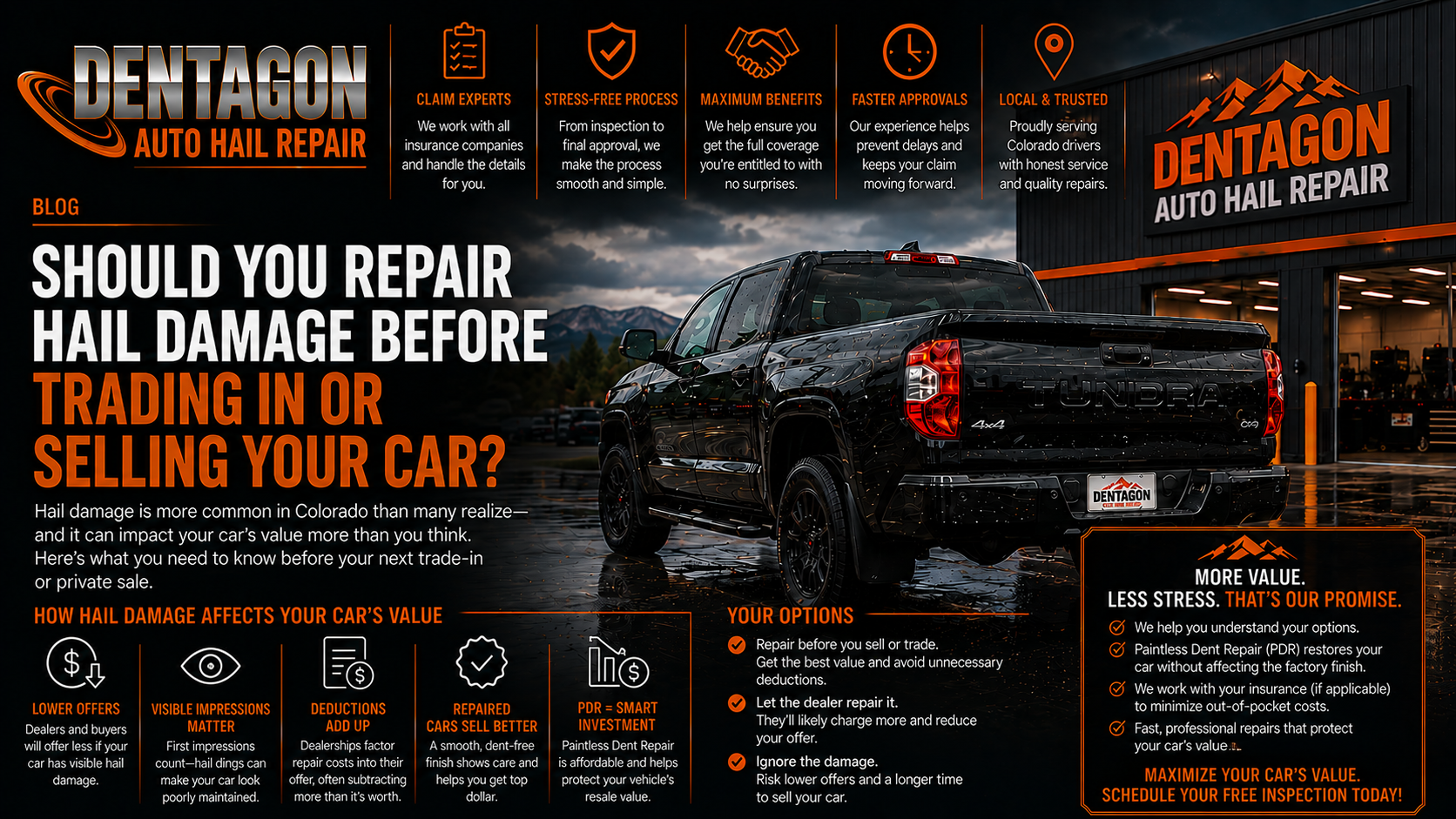
Should You Repair Hail Damage Before Trading In or Selling Your Car?
Is It Worth Fixing Hail Damage Before You Sell or Trade Your Vehicle?
If you’re thinking about selling or trading in a hail-damaged vehicle, you may be wondering whether you should repair the dents first or simply sell the vehicle as-is.
The answer depends on several factors, including the severity of the hail damage, the value and age of your vehicle, your insurance coverage, your deductible, and how you plan to sell the vehicle.
Visible hail damage can affect how potential buyers and dealerships evaluate a vehicle. Even when the damage is cosmetic and the vehicle drives perfectly, dents across the hood, roof, trunk, or body panels can make the vehicle less desirable and may reduce what someone is willing to pay for it.
For many vehicles, Paintless Dent Repair (PDR) provides a way to restore qualifying hail damage without sanding, body filler, or repainting.
Before accepting a reduced trade-in offer or selling a hail-damaged vehicle for less than expected, having the damage professionally inspected can help you understand your options.
Dentagon Auto Hail Repair offers FREE hail damage inspections for drivers throughout Denver and the surrounding metro area.
Does Hail Damage Affect Trade-In Value?
Yes, hail damage can affect a vehicle’s trade-in value.
When a dealership evaluates a trade, it isn’t only looking at the engine, mileage, and mechanical condition. The exterior condition also plays a role in determining how much the dealership is willing to offer.
A dealership acquiring a hail-damaged vehicle may have to:
• Repair the damage before resale
• Sell the vehicle with existing damage
• Send the vehicle to auction
• Account for repair costs when calculating its offer
• Consider how the damage affects buyer demand
Those factors can influence the amount offered for your vehicle.
The more extensive the hail damage, the more significant the potential effect may be.
Should I Fix Hail Damage Before Trading In My Car?
In many cases, it’s worth at least finding out what the repair would involve before trading in a hail-damaged vehicle.
That doesn’t mean every vehicle should automatically be repaired.
Instead, compare your options.
Consider:
• Current vehicle value
• Severity of the hail damage
• Estimated repair cost
• Insurance coverage
• Your comprehensive deductible
• Whether the damage qualifies for Paintless Dent Repair
• Expected trade-in value with the damage
• Your plans for replacing the vehicle
A professional hail inspection gives you information you can use before negotiating with a dealership.
If your vehicle qualifies for an insurance-covered repair and can be restored with Paintless Dent Repair, repairing the damage before trading it may be worth considering.
Should I Repair Hail Damage Before Selling My Car Privately?
Appearance can be especially important when selling a vehicle directly to another person.
Online vehicle listings are highly visual.
Potential buyers typically see photographs before they ever inspect or drive the vehicle.
A hood, roof, or trunk covered with visible dents can immediately affect the buyer’s perception of the vehicle.
Even if the damage is cosmetic, buyers may wonder:
• How much will repairs cost?
• Is there additional damage I can’t see?
• Was an insurance claim filed?
• Has the vehicle been properly maintained?
• Should I offer less because of the damage?
Repairing qualifying hail damage can remove that uncertainty and improve the overall presentation of the vehicle.
How Much Does Hail Damage Reduce Trade-In Value?
There isn’t a universal amount.
Hail damage doesn’t automatically reduce every vehicle’s value by a specific percentage.
The potential impact depends on factors such as:
• Make and model
• Model year
• Mileage
• Overall condition
• Current market value
• Number of dents
• Dent size and severity
• Number of damaged panels
• Paint damage
• Previous repairs
• Local vehicle demand
A newer vehicle with extensive hail damage may experience a very different valuation adjustment than an older vehicle that already has significant cosmetic wear.
This is why getting the actual damage inspected is more useful than relying on a generic online percentage.
Get an Inspection Before Accepting a Lower Trade-In Offer
If a dealership tells you that your vehicle is worth significantly less because of hail damage, you don’t necessarily have to accept that valuation without first understanding the damage.
Have the vehicle professionally inspected.
A hail damage inspection can help determine:
• How many panels are damaged
• Approximate severity of the dents
• Whether the factory paint remains intact
• Whether Paintless Dent Repair is appropriate
• Whether conventional repair may be necessary
• Whether insurance coverage may apply
Once you understand the condition of your vehicle, you can make a better-informed decision about repairing it, trading it, or selling it as-is.
Can Paintless Dent Repair Restore a Hail-Damaged Vehicle?
Many hail-damaged vehicles are excellent candidates for Paintless Dent Repair.
PDR is a specialized repair method that reshapes damaged metal while preserving the original factory paint whenever possible.
Instead of sanding the panel, applying body filler, and repainting it, technicians use specialized tools and techniques to carefully work the metal back toward its original shape.
PDR is commonly used to repair:
• Hail dents
• Door dings
• Minor dents
• Shallow creases
• Hood dents
• Roof dents
• Trunk dents
• Fender dents
• Quarter-panel dents
A vehicle can sometimes have dozens or even hundreds of hail dents and still qualify for Paintless Dent Repair.
Learn more about our Paintless Dent Repair services.
Why Preserving Factory Paint Can Matter When Selling Your Vehicle
One of the biggest advantages of Paintless Dent Repair is the ability to preserve the original factory finish.
When qualifying damage can be repaired with PDR, there’s generally no need for:
• Body filler
• Sanding
• Primer
• Repainting
• Paint blending
• Clear-coat refinishing
That eliminates paint-matching concerns and keeps the original factory finish intact on the repaired panel.
When preparing a vehicle for resale or trade-in, maintaining as much of the vehicle’s original condition as possible can be beneficial.
What If the Hail Damage Is Only Cosmetic?
Most automotive hail damage is cosmetic, but cosmetic doesn’t necessarily mean irrelevant to the vehicle’s value.
Imagine two otherwise identical vehicles with similar mileage and mechanical condition.
One has a clean, smooth exterior.
The other has dozens of visible dents across its hood and roof.
Even if both vehicles operate exactly the same, many buyers are likely to prefer the vehicle without visible damage.
That’s why cosmetic condition matters when selling or trading a vehicle.
Does Insurance Cover Hail Damage Before I Sell the Car?
Hail damage is commonly covered when a vehicle has comprehensive auto insurance, subject to the specific policy’s deductible, exclusions, limits, and other terms.
If your vehicle was damaged during a covered hailstorm, you may be able to have the damage repaired through your comprehensive coverage before selling or trading the vehicle.
If you’re unsure whether you have comprehensive coverage, review your policy or contact your insurance company.
Dentagon can assist with the repair-related portion of qualifying hail damage claims.
We help with:
• Reviewing insurance estimates
• Documenting hail damage
• Communicating with insurance adjusters
• Supplemental estimates when additional covered damage is identified
• Repair documentation
• Explaining the repair process
Learn more about our Insurance Claims Assistance program.
What If I’ve Already Received an Insurance Check?
If you’ve already filed a hail claim and received an insurance payment, don’t automatically assume you know the final cost of repairing the vehicle.
The initial insurance estimate may not include every dent or repair operation.
Professional PDR lighting can reveal additional hail damage that wasn’t obvious during the original inspection.
If additional covered damage or necessary repair procedures are identified, the repair facility may be able to submit supplemental documentation to the insurance company for review.
If you’ve already received an insurance estimate, bring it with you to your inspection.
Dentagon can review the repair-related information and help explain what happens next.
Can I Sell a Car With Unrepaired Hail Damage?
Yes. A vehicle can generally be sold with cosmetic hail damage, provided you comply with applicable disclosure and title requirements.
The bigger question is whether selling it damaged makes financial sense.
A buyer may expect a discount because they’re taking responsibility for the existing damage.
Dealerships may also reduce their trade-in offer to account for the vehicle’s condition and potential repair costs.
Before selling the vehicle as-is, compare that option with the potential benefits and costs of having the damage repaired.
What If My Car Is Leased or Financed?
This is an important consideration.
If you don’t own the vehicle outright, your lender or leasing company has a financial interest in it.
Insurance payments may sometimes include a lender or other lienholder, and lease agreements may contain requirements regarding vehicle condition when the vehicle is returned.
If you’re planning to trade, sell, or return a financed or leased vehicle with hail damage, review your financing or lease agreement and contact the appropriate company if you’re unsure about its requirements.
Don’t assume that keeping an insurance payment and leaving the damage unrepaired is permitted simply because the vehicle still drives normally.
Should I Repair Hail Damage Before Returning a Lease?
If you’re approaching the end of a lease, existing hail damage could potentially be considered beyond normal wear and tear.
The exact standards depend on your lease agreement and leasing company.
Before returning the vehicle:
• Review your lease-end damage guidelines
• Have the hail damage professionally inspected
• Determine whether insurance coverage applies
• Compare potential repair options
• Contact the leasing company if necessary
Finding out what you’re dealing with before the lease inspection gives you more time to make a decision.
What If My Vehicle Has Been Hail Damaged More Than Once?
Colorado vehicles can experience multiple hailstorms.
If your vehicle already has unrepaired hail damage and is hit again, determining which dents came from which storm can become more complicated.
Separate storms may also represent separate loss events for insurance purposes.
That’s one reason we recommend documenting hail damage and having the vehicle inspected rather than simply ignoring it indefinitely.
If your vehicle has been hit by multiple storms, be accurate about the dates and circumstances when communicating with your insurance company.
Does a Hail Damage Claim Appear on CARFAX?
There isn’t a universal rule stating that every hail claim or Paintless Dent Repair will—or will not—appear on a particular vehicle history report.
Vehicle history companies obtain information from numerous sources, which can include insurance companies, repair facilities, dealerships, government agencies, and other data providers.
Be cautious of anyone guaranteeing that a particular repair will never appear on a vehicle history report.
The primary advantage of Paintless Dent Repair isn’t avoiding a vehicle history report. It’s the ability to restore qualifying damage while preserving the original factory finish.
What About Diminished Value?
Diminished value generally refers to a potential difference between a vehicle’s market value before damage and its value after damage and repairs.
However, diminished-value claims are often discussed in the context of collisions involving another responsible driver.
Hail damage is generally handled under comprehensive coverage and can involve different insurance considerations.
Don’t assume that diminished-value rules associated with collision claims automatically apply to a hail claim.
If you have questions about a specific diminished-value or insurance issue, consult your insurance company or an appropriately qualified professional.
Is It Better to Repair the Vehicle or Take the Lower Trade-In Value?
There isn’t one answer that applies to everyone.
If you’re trying to decide, compare the actual numbers.
For example, consider:
Option 1: Trade or sell the vehicle with existing hail damage.
versus:
Option 2: Repair the vehicle first and then obtain a trade-in or sale offer.
The right decision depends on the vehicle, damage, insurance coverage, deductible, repair options, and the difference between the two potential valuations.
The first step is knowing how much damage actually exists.
That’s where a professional inspection can help.
Why Choose Dentagon Before Selling or Trading Your Vehicle?
Dentagon Auto Hail Repair specializes in automotive hail damage and Paintless Dent Repair.
We’ll inspect your vehicle and explain your options so you can make an informed decision before selling or trading it.
Drivers choose Dentagon for:
✓ Free Hail Damage Inspections
✓ Paintless Dent Repair Specialists
✓ Insurance Claims Assistance
✓ Deductible Assistance for Qualifying Repairs
✓ Lifetime Warranty
✓ Honest Recommendations
✓ Exceptional Customer Service
Our goal isn’t to tell every customer that they must repair their vehicle.
It’s to help you understand the damage and available repair options so you can decide what makes sense for your situation.
Serving Denver and Surrounding Communities
Dentagon provides professional hail damage inspections and Paintless Dent Repair throughout the Denver metro area, including:
• Arvada
• Aurora
• Brighton
• Broomfield
• Castle Rock
• Centennial
• Denver
• Englewood
• Highlands Ranch
• Lakewood
• Littleton
• Parker
• Westminster
Whether you’re preparing to trade your vehicle, sell it privately, return a lease, or simply want to restore its appearance, our team can help determine whether Paintless Dent Repair is appropriate.
Schedule a Free Inspection Before You Sell or Trade
Before accepting less for a hail-damaged vehicle, find out what you’re actually dealing with.
Dentagon Auto Hail Repair can inspect the damage, determine whether your vehicle qualifies for Paintless Dent Repair, explain your repair options, and help with the repair-related insurance process when applicable.
A free inspection gives you information you can use when deciding whether to repair the vehicle, sell it as-is, or trade it.
Schedule your FREE hail damage inspection today.